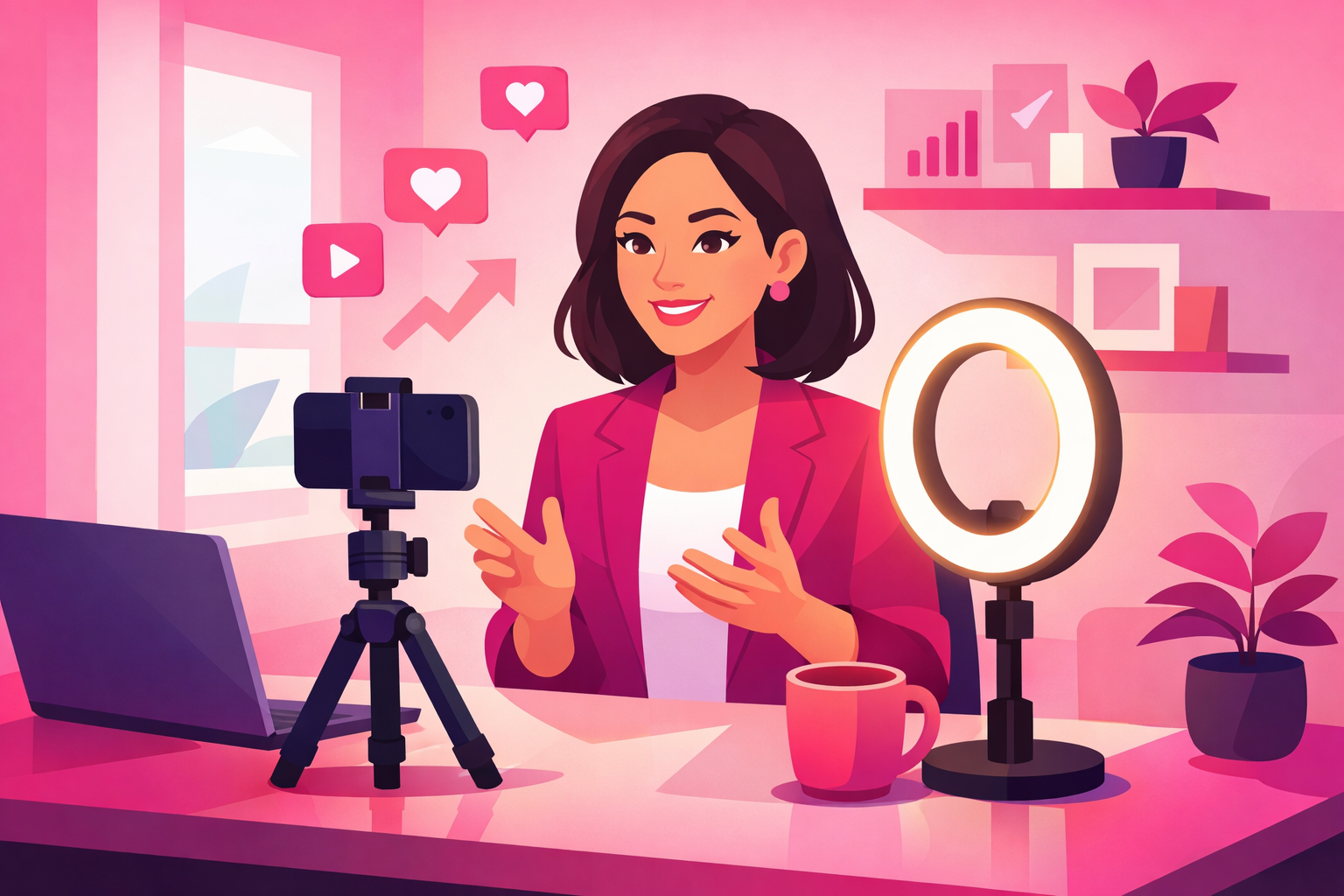
Here's the strange thing about filming coaching videos: the skill that books clients - coaching - is one you already have. Yet the moment the camera turns on, most coaches stop coaching and start presenting. The warmth flattens, the pace stiffens, and the person who is magnetic in a session becomes forgettable on a phone screen.
The camera isn't the problem. The setup and the delivery habits are - and both are fixable in an afternoon, for less than $60, without a single piece of professional gear.
This guide covers the whole filming pipeline for coaches: the 10-minute studio setup, the eye-level framing that builds trust, the audio bar you actually have to clear, the Coach-One-Person delivery method that fixes stiffness at the root, captions that keep mute viewers watching, and the one-hour batch system that films a week of content in one sitting. It pairs with our complete TikTok guide for coaches and consultants (the strategy) and our 50+ coach content ideas vault (the what) - this is the how.
The honest summary:
- Phone, tripod, window - that's the studio. Coaching content filmed at eye level on a phone outperforms studio polish because it reads as a conversation.
- Audio is the real quality bar. Viewers forgive imperfect video and scroll past bad sound in about two seconds.
- Talk to one person, not an audience. The stiffness fix isn't practice - it's picturing the client who actually asked the question.
- When a filmed video proves itself, use selective amplification to put it in front of thousands more people who match your ideal client profile.
What's Inside
- 1. The Coaching Quality Bar: Why Polish Can Hurt You
- 2. The 10-Minute Studio: Gear & Setup Under $60
- 3. Framing & the Eye-Level Trust Rule
- 4. Audio: The Bar You Actually Have to Clear
- 5. Delivery: The Coach-One-Person Method
- 6. Captions & On-Screen Text for Mute Viewers
- 7. The One-Hour Batch System: Film a Week of Coaching Videos
- 8. Editing: Cut to the Payoff
- 9. When a Video Lands: Amplifying Your Proven Clips
- Frequently Asked Questions
1. The Coaching Quality Bar: Why Polish Can Hurt You
Before buying anything, understand what production quality means in this niche - because coaching has an unusual bar. Hiring a coach is a trust purchase, and trust is built by watching a real person give real answers. Over-produced footage - studio backdrops, cinematic color grading, teleprompter delivery - quietly signals marketing, and viewers discount marketing.
From our experience helping creators grow, talking-head advice clips filmed on a phone in a real workspace routinely out-perform professionally produced versions of the same script - we've seen completion-rate gaps of 15-20% in favor of the "less polished" take. The authenticity reads as proof: this is what I'm actually like, and this is what working with me would feel like.
But - and this is the part most "just be authentic" advice skips - authentic doesn't mean careless. Three things are non-negotiable because they affect whether people can comfortably consume the video at all: stable framing, clean audio, and readable captions. Everything in this guide serves those three, and almost nothing else matters.
2. The 10-Minute Studio: Gear & Setup Under $60
The 10-Minute Studio is a filming spot you set up once and return to for every video - same corner, same light, same framing. The consistency isn't just efficiency: a repeated visual environment becomes part of your brand, and it removes the "where do I film?" friction that kills posting streaks.
- Your phone. Any smartphone from the last three or four years shoots better video than the cameras most agencies used a decade ago. Use the back camera when you can (it's sharper than the selfie camera), clean the lens with your shirt - the single highest-ROI move in mobile filming - and shoot vertical, 9:16, always.
- A tripod ($15-25). A small desk tripod or a flexible mount. Handheld advice videos read as chaotic; a locked-off frame reads as calm competence, which is exactly the feeling you're selling.
- A window. Face the largest window in the room so daylight hits your face at roughly 45 degrees. Never film with the window behind you - backlight turns you into a silhouette, and viewers don't trust a face they can't see.
- A ring light ($30, optional). Only needed for evening filming or dark rooms. Set it slightly above eye level so it flatters rather than flattens.
- A background that says something true. Bookshelf, plant, tidy desk, a bit of depth behind you. It shouldn't be interesting enough to compete with your face - just intentional enough to not be a bare wall or an unmade bed.
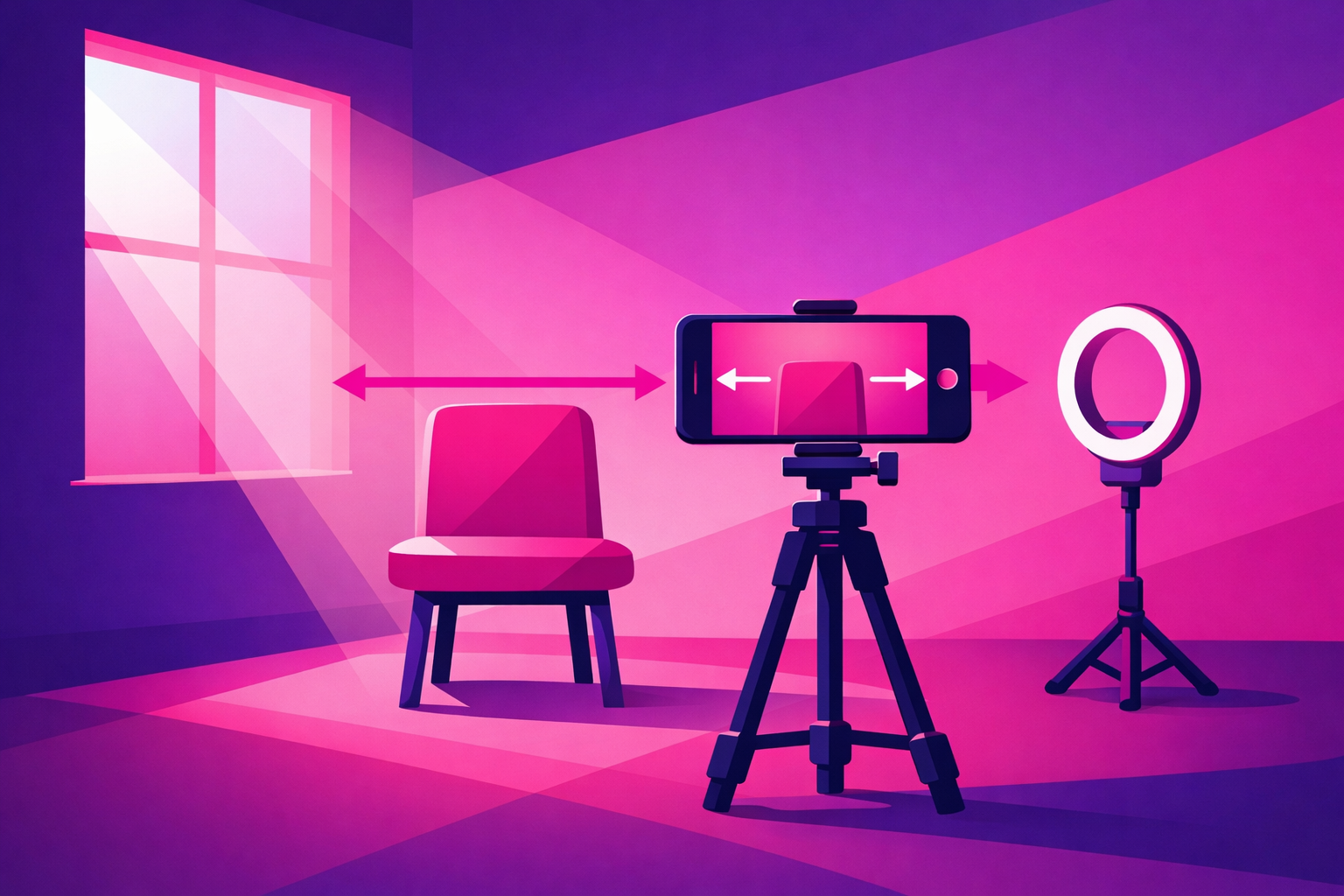
Total spend: under $60, and most coaches already own two of the three essentials. If you're tempted to buy more gear before posting more videos, that's procrastination wearing a productive costume. The setup is done in ten minutes; the compounding comes from using it five times a week.
3. Framing & the Eye-Level Trust Rule
Here's the framing principle that matters more than any other in coaching content - we call it the Eye-Level Trust Rule: the lens sits at your eye height, and you look at the lens, not the screen. A camera looking up at you turns advice into a lecture from a stage. A camera looking down turns you into someone small on a video call. Eye level is a conversation between equals - which is the exact relationship a discovery call needs.
- Distance: close enough that your head and shoulders fill the frame - roughly an arm's length. Advice delivered from across the room feels distant in both senses.
- Headroom: a small gap between the top of your head and the top of the frame. Your eyes should sit around the upper third of the screen, which conveniently leaves the lower third free for captions.
- Eye contact: look at the tiny lens, not at yourself in the preview. Viewers can feel the difference even if they can't name it - preview-watching reads as slightly evasive, lens contact reads as direct.
- Stability: locked on the tripod. Save handheld, walking-and-talking energy for behind-the-practice content, where a bit of motion suits the format.
One habit seals it: record three seconds of yourself before every batch, watch it back, and check the three points - eye level, arm's length, eyes on lens. It takes fifteen seconds and catches nearly every framing drift before it costs you a filming session.
4. Audio: The Bar You Actually Have to Clear
Here's the deal: viewers forgive soft focus, imperfect lighting, and phone-camera video. They do not forgive audio that's echoey, muffled, or buried under background noise - bad sound triggers a scroll within a couple of seconds, before your advice ever gets a hearing. For talking-head advice content, audio quality is production quality.
- Film in a soft room. Echo comes from bare walls and hard floors. A rug, curtains, a sofa, even filming toward an open closet of clothes deadens the room for free. The bathroom-echo sound is the fastest way to make good advice feel amateur.
- Stay within an arm's length. Phone microphones are good at short range and fall apart with distance. If your setup keeps you close, you may not need a mic at all.
- The $20-30 upgrade: a wireless clip-on mic. A budget lavalier clipped to your collar makes a phone video sound professionally produced and frees you to sit further back. It's the single best money-for-quality trade in this entire guide.
- Kill the noise you've stopped hearing. Fans, HVAC, a dishwasher two rooms away - you've tuned them out; the microphone hasn't. Ten seconds of silence recorded before your batch will tell you what the mic is actually picking up.
A useful test: play your last video back with your eyes closed. If it sounds like someone talking to you across a table, you've cleared the bar. If it sounds like a recording of someone in a room, fix the room before you film another take.
5. Delivery: The Coach-One-Person Method
Now the part gear can't fix. The reason coaching videos come out stiff is almost never camera shyness - it's that the coach is performing for an imaginary audience instead of talking to a person. Crowds get presentations; people get coaching. The camera gives you a crowd by default, so you have to consciously replace it.
The Coach-One-Person Method replaces it in three steps:
- Pick the person. Before recording, picture the specific client who actually asked this question - their face, their frustration, the session where it came up. You're not making content; you're answering them.
- Outline, don't script. Write the hook word-for-word (the first line has to be exact), then three bullets for the body. Reading a script produces script-voice, and script-voice is the death of coaching content. You've explained this concept dozens of times in sessions - trust that.
- One take, then post. Take one is usually the most natural you'll be; take five is usually the most rehearsed. A small stumble, a mid-sentence correction, a laugh - these read as credibility, not error. The slightly imperfect version is the more convincing version.
Two mechanical notes: talk at your normal session pace (nervous coaches speed up about 20%, and rushed advice feels less considered), and let your hands into the frame - coaches talk with their hands in session, and pinning them off-camera visibly drains the delivery. The goal isn't to become a performer. It's to let the camera see the coach your clients already pay for - the same trust-first posture our coaches pillar guide builds the whole strategy around.
6. Captions & On-Screen Text for Mute Viewers
A majority of short-form advice content is watched with the sound off - on commutes, in offices, in bed next to a sleeping partner. For a coach, that has a blunt implication: a video without captions simply doesn't exist for a large share of the people deciding whether to trust you.
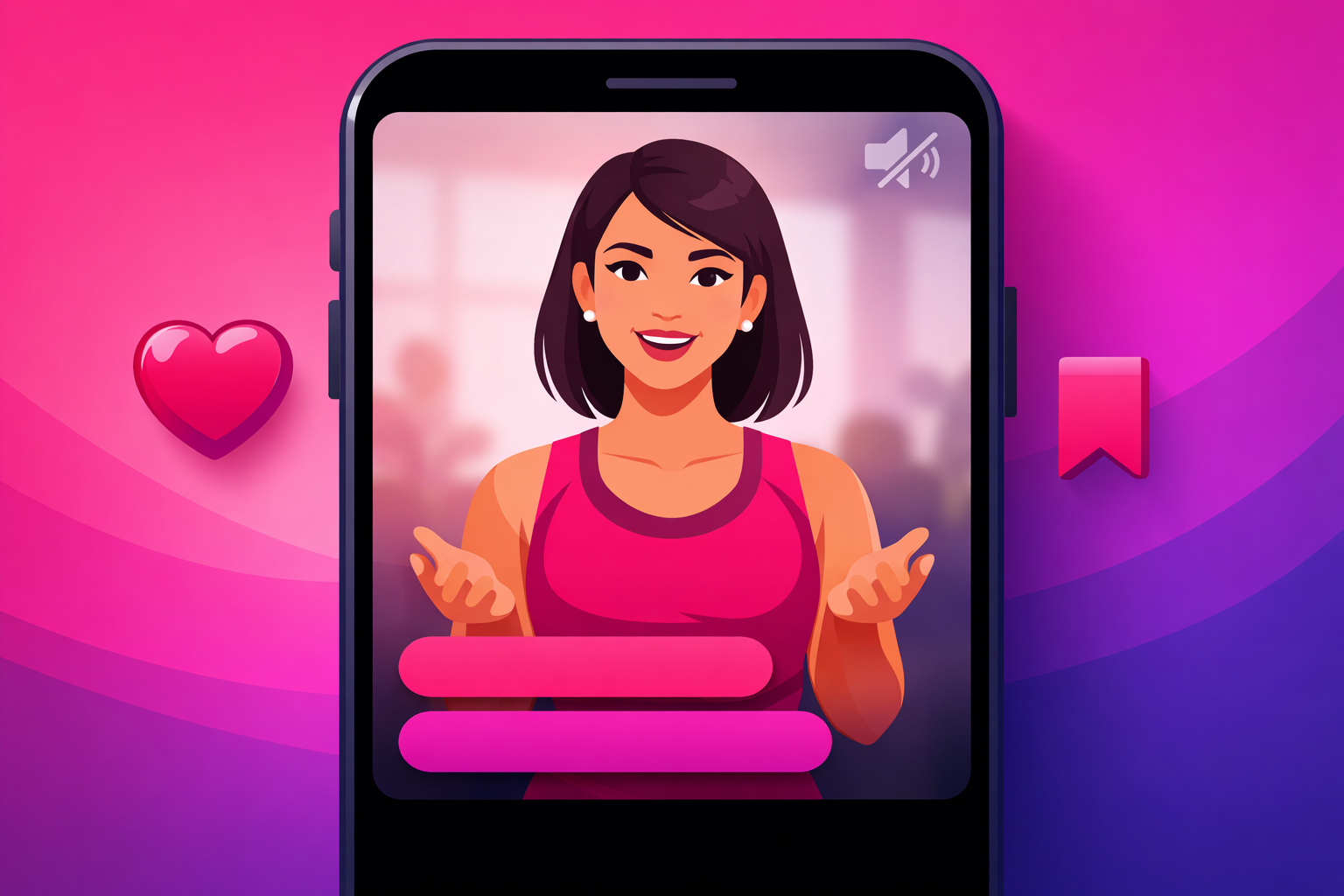
- Auto-generate, then correct by hand. TikTok's built-in captions or CapCut's auto-captions get you 95% of the way. The remaining 5% is where authority lives: fix every mangled framework name, number, and client phrase. A caption that misquotes your own method undermines the exact expertise the video exists to prove.
- Put the hook on screen in the first second. A bold text line - the client's question in their exact words, the result, the contrarian claim - before you've finished your first sentence. Mute scrollers decide whether to stop based on what they can read.
- Keep captions in the lower third. Below your face, above TikTok's UI elements. Never over your eyes - eye contact is doing trust work you don't want covered.
- One style, every video. Same font, same placement, same color. Caption consistency is branding that costs nothing.
Captions also feed the machine: TikTok reads caption text as a ranking input, so accurate captions full of the words your ideal clients search - "salary negotiation," "burnout," "pricing" - help the algorithm route your advice to the right people. Our TikTok algorithm guide covers how those categorization signals decide who sees your videos.
7. The One-Hour Batch System: Film a Week of Coaching Videos
Filming one video per day is the cadence that breaks coaches - the setup, the mental warm-up, the context switch from client work, five separate times a week. Batching collapses all of it into a single hour that produces the entire week.
- Minutes 0-10: stack the questions. Pull five to seven topics from your client-question log - the capture system from our content ideas vault - and write one hook line plus three bullets for each. No full scripts.
- Minutes 10-50: film straight through. Sit down in the 10-Minute Studio and record all five to seven, one take each, Coach-One-Person for every video. Swap a jacket or top between clips if you want the week to look varied - a two-second change that makes batched content read as daily content.
- Minutes 50-60: file the takes. Move the clips into a folder for the week. Edit and caption later, in a separate sitting - filming energy and editing energy are different energies, and mixing them doubles the time both take.
The bottom line: one hour a week sustains the five-to-seven video cadence that growth requires, which is why batching coaches are still posting in month six while film-it-daily coaches quietly stopped in month two. Consistency isn't a personality trait - it's a system property.
8. Editing: Cut to the Payoff
Coaching videos need less editing than almost any other content type - no effects, no transitions, no zoom gymnastics. Editing advice content is subtraction: remove everything between the viewer and the answer.
- Payoff in the first three seconds. If the take warmed up slowly, cut the warm-up. The video starts where the value starts - outcome first, context after, exactly the proof-first structure that separates advice that travels from advice that stalls.
- Trim the dead air. Cut pauses longer than about half a second and any sentence that restates the previous one. You're not making jump-cut chaos - just keeping the thought moving at session pace.
- Land on 25-45 seconds. The sweet spot for a complete answer with a high completion rate. Framework teaching can stretch to 60-90 seconds when every second earns its place; if a topic needs three minutes, it's usually three videos.
- End on the completed thought. No "anyway, follow for more" outro - trailing endings are where completion rates go to die. Finish the answer, hold a beat, done.
CapCut (free) handles everything a coach needs: trims, auto-captions, and a saved caption style you can reapply weekly. Total editing time for a batch of six videos, once the routine is set: about thirty minutes.
9. When a Video Lands: Amplifying Your Proven Clips
Film and post consistently with this system and the data will eventually hand you a gift: a video that clearly out-performs - completion above 50%, saves stacking up, profile visits and booking-link taps spiking. That video has proven, at zero cost, that its message stops your ideal client mid-scroll.
For coaches, that proof is unusually valuable. A follower who matches your ideal client profile is a warm lead for an offer worth thousands, so putting a proven advice clip in front of more of exactly those people has a payback most niches can't match - one converted client can repay months of promotion budget. That's the model our TikTok promotion service is built on: selective amplification of videos that already cleared the organic bar, targeted to the audience most likely to become clients - never boosting unproven uploads and hoping.
The filming quality you've built in this guide is what makes amplification work: promotion puts your video in front of colder viewers, and clean audio, eye-level framing, and accurate captions are what make a stranger stay. For the mechanics of promoting organic posts through TikTok's native format, see the Spark Ads guide.
Frequently Asked Questions
What equipment do I need to film coaching videos for TikTok?
A smartphone from the last three or four years, a $15-25 phone tripod, and a window. That is genuinely the whole list to start. The two upgrades worth making once you post consistently are a $20-30 wireless clip-on microphone (audio quality matters more than video quality for advice content) and a $30 ring light for filming after dark. Skip the professional camera - coaching content filmed on a phone at eye level consistently outperforms studio footage because it reads as a conversation, not a production.
How long should a coaching TikTok video be?
25 to 45 seconds for most advice clips: long enough to answer one narrow question completely, short enough to keep completion rate high - and completion rate is the dominant ranking signal. Framework teaching videos can run 60-90 seconds when every second earns its place, and client transformation stories often land best around 45-60 seconds. If a topic genuinely needs three minutes, it is usually three videos.
Should coaches script their TikTok videos?
Outline, don't script. Write the hook word-for-word (it has to be exact), then three bullet points for the body, then deliver it the way you would explain it to a client in session. Fully scripted coaching videos almost always read as stiff - and stiffness is expensive in a niche where viewers are deciding whether they trust you enough to book a call. The one exception: put the client's question on screen in their exact words, because their phrasing is your best hook.
Why do my coaching videos feel awkward and stiff?
Almost always because you are presenting to an imaginary audience instead of talking to one person. The fix is the Coach-One-Person method: before recording, picture a specific client who actually asked this question, and answer them - same pace, same warmth, same directness you use in session. Two mechanical fixes help too: put the lens at eye level so you are not looking down at viewers, and look at the lens rather than your own preview. Coaches are usually excellent on camera the moment they stop performing and start coaching.
Do captions really matter for coaching videos on TikTok?
Yes - a majority of short-form advice content is watched with the sound off, so a coaching video without captions is invisible to a large share of its audience. Use auto-captions in TikTok or CapCut, then correct every error by hand: a transcription mistake in a framework name or a number quietly undermines the authority the video exists to build. Add a bold on-screen hook line in the first second as well, since mute scrollers decide whether to stop based on what they can read, not what they could hear.
Filmed a video that's already booking calls?
Don't let your best clip plateau at the reach the algorithm handed it. Viryze amplifies coaching videos that have already proved themselves - putting your winning advice in front of thousands more people who match your ideal client profile, so every new follower is a warm lead for your practice.
Amplify your best coaching videoRelated Reading
- TikTok for Coaches & Consultants: The Complete 2026 Guide - the full strategy this filming system plugs into.
- Coach TikTok Content Ideas: 50+ Advice Video Concepts - what to film once your setup is ready.
- The Complete TikTok Algorithm Guide - the ranking signals your completion rate and captions feed.
- How to Film Educational Content for TikTok - the adjacent playbook for teaching-heavy formats.
- Health Coach TikTok Marketing - the health-coaching angle on on-camera advice.

Head of Creator Success at Viryze
TikTok growth strategist helping creators reach their first 100K followers through data-driven promotion strategies.