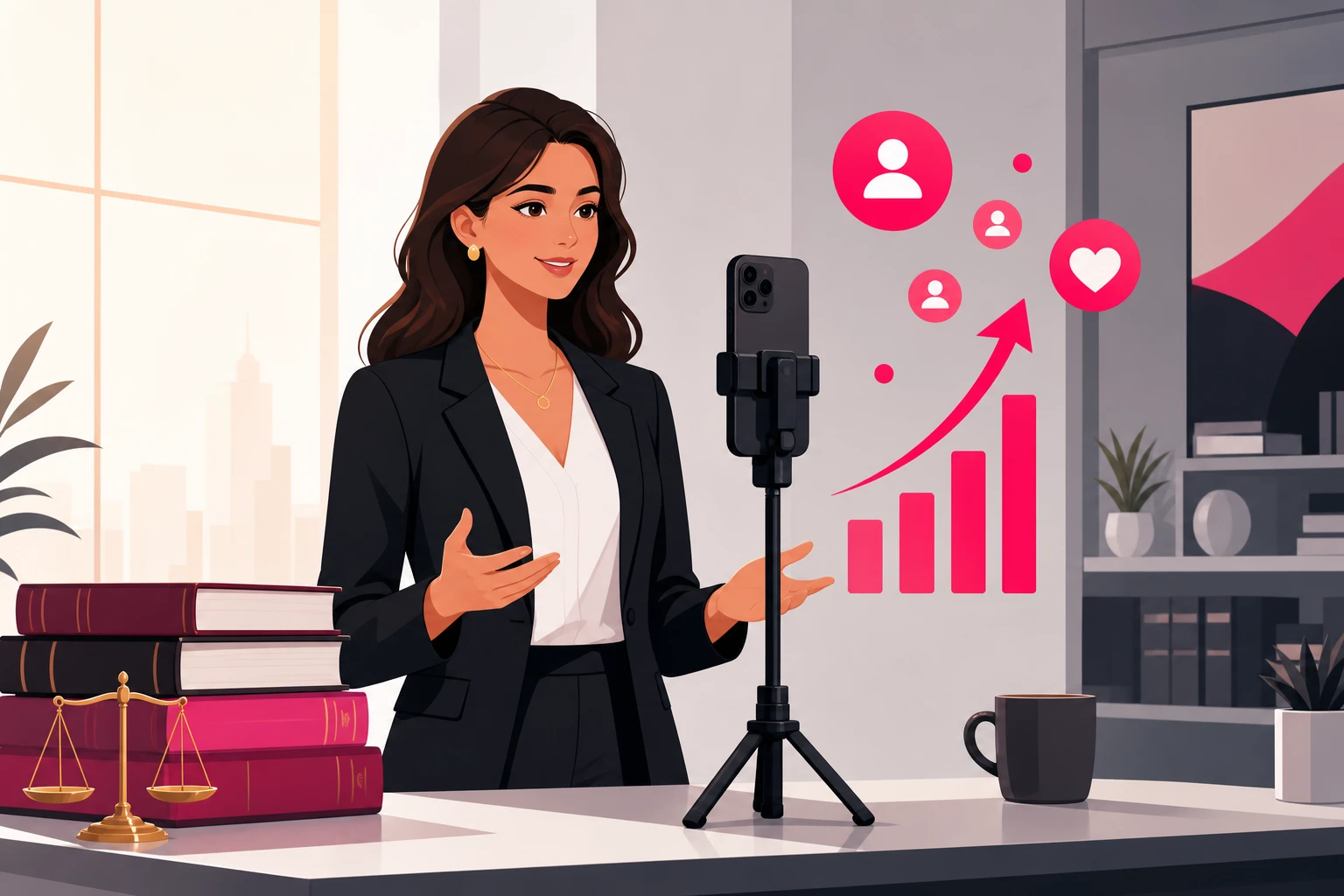
A click on the phrase "car accident attorney" is one of the most expensive things you can buy on the internet. Firms routinely pay more for a single visitor - who may bounce in four seconds - than most small businesses spend on marketing in a week. Every firm in your city is bidding on the same words, at the same moment, for the same stranger who is comparing ten names they have never heard of.
Meanwhile, an attorney across town spends nine minutes a week filming herself answering the question "do I actually have to let police search my car?" She is not bidding on anything. She is simply the person forty thousand locals have watched explain their rights in plain English - so when something goes wrong at 11 PM on a Saturday, they do not open a search engine. They open her profile.
That is LawTok, and it is the clearest arbitrage in professional services right now. This guide is the complete 2026 playbook for attorneys in every practice area - personal injury, family law, criminal defense, immigration, employment, estate planning, and business counsel: the six video formats that grow legal accounts fastest, the client-question hook that stops the scroll, the case-file content engine that turns one work week into a month of posts, the 90-day plan from an empty account to your city's trusted legal voice, the retainer ladder that converts viewers into signed cases, the ethics rules that protect your license, and when paid promotion signs cases versus burns budget. Pair it with our TikTok algorithm guide for the ranking-signal frame and the TikTok growth strategy guide for the cross-niche fundamentals.
The honest summary:
- Your consult questions are the content. The things people ask you for free every week are an endless supply of videos - no trends, no dancing, no confidential information required.
- Education gets views; being human gets the call. Rights explainers earn the reach, but the personality is what makes someone choose you instead of the first name on a search page.
- Law is a local, extremely high-value service - one retained case can outweigh a year of content effort, so a small engaged local following beats a huge scattered one.
- Use paid promotion as selective amplification on proven explainers aimed at your metro - never to rescue a weak clip, and always within TikTok ad policies and your state bar's advertising rules.
What's Inside
- 1. Why TikTok Beats the $200 Click in 2026
- 2. The Six Video Formats That Grow Legal Accounts Fastest
- 3. The Client-Question Hook That Stops the Scroll
- 4. The Case-File Content Engine: A Week of Posts from the Week You Already Worked
- 5. A Posting Cadence a Billable Schedule Can Sustain
- 6. The 90-Day Plan to Your City's Trusted Legal Voice
- 7. The Retainer Ladder: Turning Viewers Into Signed Cases
- 8. When Paid Promotion Signs Cases vs. Burns Budget
- 9. Ethics, Bar Rules, and the Mistakes That Cap Legal Accounts
- Frequently Asked Questions
1. Why TikTok Beats the $200 Click in 2026
Legal marketing has run on the same three channels for forty years: referrals, billboards, and - more recently - search ads fought over at the highest costs-per-click on the internet. All three share a weakness. In every one of them, the client meets you as a name they have never heard, at the exact moment they are panicking and comparing you against nine competitors. TikTok changes the order of operations. The person who has watched you explain things clearly for two months already trusts you before the emergency, and no billboard can compete with that.
The first reason TikTok wins for attorneys is the timing of the relationship. Search ads catch people at the moment of need, which sounds ideal until you look at the price: legal terms are consistently the most expensive category in paid search, with competitive practice-area clicks routinely running from the high double digits into the hundreds of dollars - each. And for that money, the buyer still has zero preference between you and the nine firms beside you. Content catches people before the need - when nobody is bidding, attention is nearly free, and there is no competition for the slot. By the time the need arrives, the comparison is already over.
The second reason is the economics of an extremely high-value local service. A follower is worth almost nothing to a meme account. To a firm, a single retained client can be worth thousands to hundreds of thousands of dollars. That changes the math entirely: you do not need a million views, you need a few thousand people in your county who trust you. Law is the purest example of a niche where a 5,000-follower account can out-earn a 500,000-follower one, because conversion runs on trust and jurisdiction, not reach.
The third reason is the platform rewards a skill you already have. TikTok does not want a polished commercial with a gavel sound effect - it wants a real person explaining something confusing in plain language, fast. That is what litigators do to juries and what transactional attorneys do to clients every week. Most professionals have to learn that skill for camera. You have been billing for it.
Fourth, legal questions are an infinite, pre-validated content supply. "Can my landlord do this?" "Do I have to answer that?" "What happens if I just don't show up?" People have urgent, embarrassing, high-stakes legal questions constantly, and they will not pay a consult fee to ask them. Every question in your intake log is already being typed into a search bar by thousands of people - and clear answers earn the saves and shares the algorithm rewards most.
Finally, the trust lane is wide open. Most firms post nothing. Most of the rest post case-result graphics, award badges, and office announcements that convince nobody and get shown to nobody. The first attorney in a market to consistently appear as a clear, likable human being explaining people's rights becomes the legal voice for that practice area in that city - an advantage that compounds monthly and is very hard for a late-arriving competitor to displace.
For context on how the algorithm treats watch-time, saves, and other ranking signals across niches, see our algorithm ranking factors breakdown.
2. The Six Video Formats That Grow Legal Accounts Fastest
Random posting is the slowest growth path on TikTok. The algorithm wants to categorize your account so it can route your videos to the right viewers, and an office tour, then a holiday post, then a case-result graphic confuses the engine and stalls the account. Picking two or three repeatable formats - your lane - is the single highest-leverage decision an attorney makes on TikTok.
The six legal video formats growing accounts fastest in 2026:
- The know-your-rights explainer. What someone can and cannot be made to do in a common situation: a traffic stop, a landlord inspection, an HR meeting, a border question, a debt collector call. This is the backbone format of LawTok because it is immediately useful, endlessly repeatable, and gets saved for later by people who suspect they will need it.
- The myth-bust. Correct a piece of legal misinformation people repeat with total confidence - "verbal agreements aren't binding," "you get one phone call," "my ex can't take the kids out of state," "I don't need a will, my spouse gets everything." Myth-busts travel farthest because they carry built-in tension and give viewers something to argue about in the comments.
- The what-actually-happens walkthrough. Step through a process that terrifies people because they cannot picture it: what a deposition really feels like, what happens at a first court date, what a consult actually involves, how long a case like this takes. Fear of the unknown is the number one reason people delay calling a lawyer - the attorney who removes that fear on camera is the one they call.
- The comment-reply Q&A. Use TikTok's video-reply feature to answer real questions from your comments on camera (as general information, never as advice to that person). It is the highest-trust format in law - viewers watch you take an ordinary person's problem seriously - and it compounds, because every answer surfaces three new questions to answer next.
- The news-reaction take. Explain the actual law behind a story everyone is already discussing. You inherit an enormous existing search and interest wave, and you get to demonstrate judgment rather than just knowledge. Keep it about the legal mechanics, not hot takes about the parties.
- The personality clip. The human behind the suit: courthouse-parking frustrations, the reality of law school debt, what your job is actually like versus what TV shows. People hire lawyers they like. This format is what converts a follower who respects you into a client who calls you.
Pick two as your core and one as an occasional third. A criminal defense attorney might run rights explainers plus myth-busts, with personality clips on Fridays. An estate planning attorney might run what-actually-happens walkthroughs plus comment-reply Q&A. The specific combination matters far less than the consistency of it.
3. The Client-Question Hook That Stops the Scroll
Attorneys lose more views in the first two seconds than anywhere else, and it is almost always the same mistake: starting with themselves. "Hi, I'm a board-certified family law attorney with over fifteen years of experience..." is a scroll trigger. The viewer has no reason to care who you are yet - you have not given them a reason.
The fix is what we call the client-question hook: open with the exact question a real person asked, in their words, and answer it immediately. The credentials can come at second twelve, once the viewer is already invested - or never, because your profile handles it.
Weak opens vs. strong opens
- Weak: "Today I want to talk about tenant rights."
Strong: "Your landlord just walked in without knocking. Here's what you can legally do about it." - Weak: "An important topic in criminal defense is search and seizure."
Strong: "'Do you mind if I take a look in your trunk?' is not a question. It's a trap." - Weak: "Let's discuss estate planning."
Strong: "If you die without a will in this state, your spouse might not get the house. Here's who does."
Three rules make legal hooks work. First, use their words, not yours. Nobody searches "dissolution of marriage" - they type "how do I get divorced if he won't sign." Second, lead with the stakes: what the viewer could lose or protect in the next thirty seconds. Third, answer fast, then expand. Give the real answer in the first eight seconds, then explain the nuance - the modern viewer will not wait through a windup, and the completion rate is what determines whether the video travels.
One more thing that quietly matters: say the thing you are legally allowed to say plainly, without hedging it into meaninglessness. "It depends on the facts" is true and it is also the reason most legal content dies. Give the general rule clearly, then name the exceptions - that is both accurate and watchable.
4. The Case-File Content Engine: A Week of Posts from the Week You Already Worked

The reason most attorneys quit TikTok in six weeks is not the ethics rules and it is not the camera. It is that they treat every video as a separate creative project on top of a full docket. The firms that sustain it stop "making content" and start capturing what already happens, then batch it.
Five capture points across a normal work week, none of which require a single confidential detail:
- The consult question log. Keep a running note - paper, phone, whatever - of every question someone asks you in a consult, in the hallway, at a family barbecue. Write it in their phrasing, not the legal term. This single habit solves the "what do I post" problem permanently, and every entry is a pre-validated hook.
- The courthouse-steps note. Sixty seconds after a hearing, film yourself explaining one general thing that surprises people about what just happened as a process - how long the docket call took, why everyone was waiting, what the judge always asks. No case, no client, no facts. Just the machinery.
- The between-meetings answer. You have a fifteen-minute gap and a question from the log. One take, phone on a tripod, done. These are the workhorses of the account and they perform better than anything you would spend an hour on.
- The news-reaction take. Something in the news touches your practice area this week - a new state law, a viral incident, a policy change. Film your explanation while the interest wave is live. These are your highest-ceiling videos.
- The end-of-week rights explainer. The one deliberately-planned video of your week: the single most useful thing someone in your city could know about your practice area. Slightly more care, better lighting, tighter script. This is the video you'll pin and later amplify.
Then batch the editing. Do not edit as you go - it is the fastest way to make TikTok feel like a second job. Capture all week, then sit down once for 45 minutes: trim the fronts, add captions, write the on-screen hooks, schedule the week. Most attorneys who make this work spend under an hour a week in total, and it fits in the gaps a billable schedule already has.
One production note that saves enormous time: your phone is enough. A tripod, a window, and good audio beat a production crew, because polished legal content reads as an ad and gets scrolled. The office bookshelf behind you is plenty of set design - just make sure no screens, files, calendars, or whiteboards are legible in frame.
5. A Posting Cadence a Billable Schedule Can Sustain
The honest answer to "how often should I post" is: the most you can sustain for a year without resenting it. Three videos a week for fifty-two weeks beats daily posting for a month followed by silence - and the second pattern is what almost every firm actually does.
A realistic ladder that works for practicing attorneys:
- Weeks 1-4: three per week. Enough to learn your format and give the algorithm a signal, few enough that you will not quit. Do not evaluate performance yet - early videos are for reps, not results.
- Weeks 5-12: four to five per week. Once capture-and-batch is a habit, the extra videos cost almost nothing. This is the range where accounts usually get their first breakout.
- After a breakout: double down on the format that broke out. Not the topic - the format. If a myth-bust took off, your next four are myth-busts. The algorithm just told you what it wants to show your audience; listen to it.
Two failure modes to avoid. The first is the trial-week blackout: you vanish for three weeks during a trial and the account cools. Fix it by keeping four evergreen explainers filmed and unposted at all times as a buffer. The second is the delegation trap: handing the account to a marketing agency that posts stock-footage graphics with a gavel. It will not work, because the entire asset being built is a specific human's face and voice. An assistant can edit and schedule; only you can be on camera.
6. The 90-Day Plan to Your City's Trusted Legal Voice
Growth on a legal account is not linear, and expecting it to be is why most firms quit at week six. It moves in a flat stretch, then a step. Here is what the first ninety days should actually look like.
Days 1-30: lane lock and question mining. Choose your two core formats and one practice area to be known for - not your whole firm's service list. Set the bio to name the practice area and city plainly ("Employment lawyer in Phoenix. General info, not legal advice."). Build the question log to at least thirty entries before you worry about a single view. Post three times a week. Expect very little; you are teaching the algorithm who to show you to.
Days 31-60: series compounding. Find the videos that outperformed and turn them into numbered series - "things your boss legally cannot do, part 9"; "questions you don't have to answer, part 14." Series work extraordinarily well in legal content because they train viewers to expect more and give the algorithm a clean pattern to route. Move to four or five posts a week. Answer every comment for the first sixty days - the comments are both your distribution and your next month of content.
Days 61-90: local concentration and selective amplification. By now you should have one or two videos that clearly outperformed the rest. This is where paid promotion earns its keep: take a proven explainer and push it toward your metro area, so the audience being built is made of people who could actually retain you. A national audience is flattering; a local audience is a pipeline. See local business TikTok marketing for the local-discovery mechanics.
One expectation to set honestly: legal accounts often grow slower than entertainment accounts and convert dramatically better. Do not compare your follower count to a dance creator's. Compare your consult calendar to what it looked like in January.
7. The Retainer Ladder: Turning Viewers Into Signed Cases
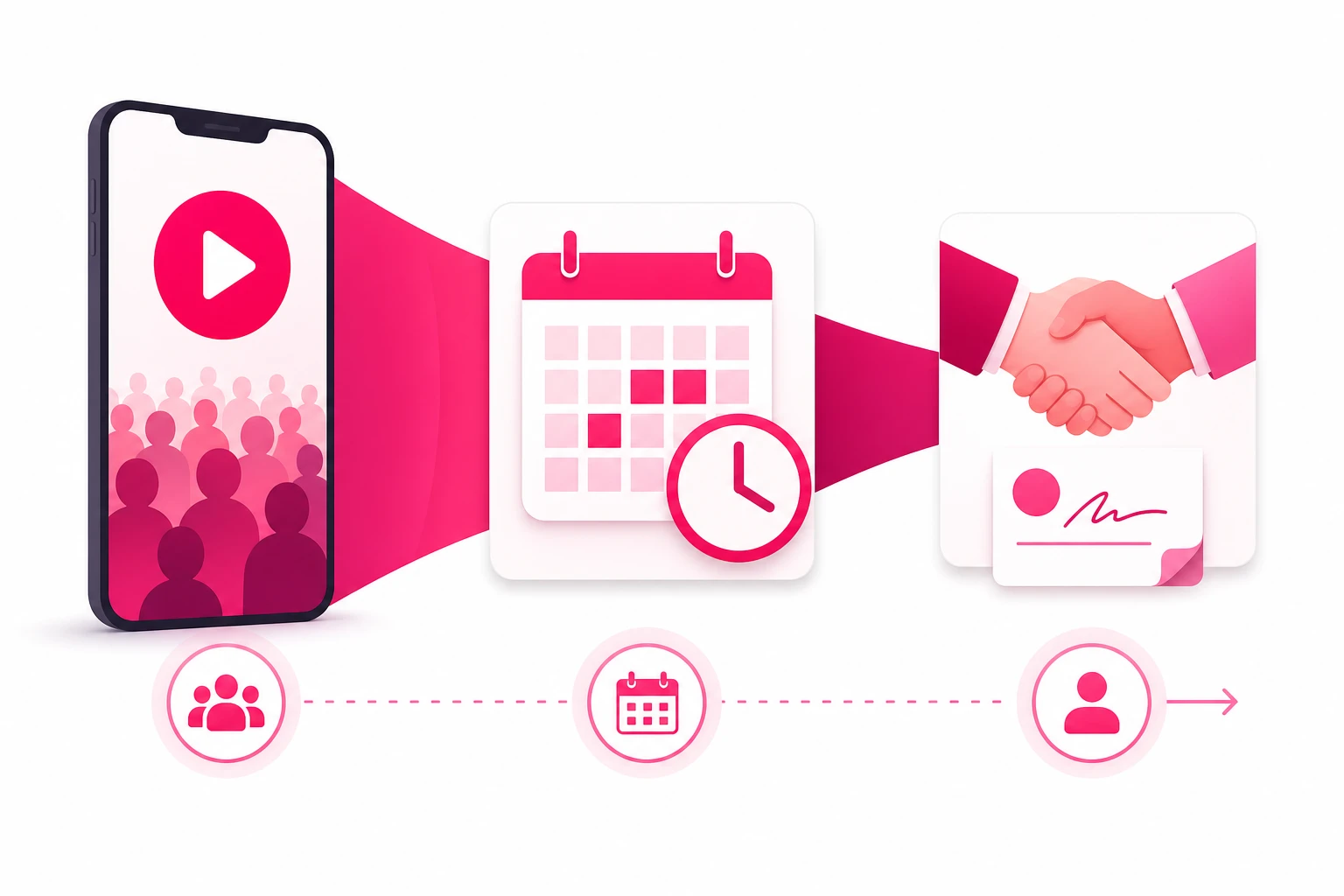
Views do not sign cases. A ladder does, and every rung is something you control:
- Viewer to follower. They watch one explainer that actually helps and follow because they suspect they will need you someday. Consistency of format is what earns this rung - people follow accounts they can predict.
- Follower to trusting local. Weeks of clear answers and a visible personality. This rung is pure time; there is no shortcut, which is exactly why it is defensible.
- Trusting local to inquiry. Something goes wrong - to them or to someone they love - and you are the only lawyer they can picture. Make this rung frictionless: a bio naming the practice area and city, a pinned trio (best rights explainer, a short who-I-help intro, the most reassuring what-happens-next video), and an intake link one tap away.
- Inquiry to consult. Speed decides this rung. Legal inquiries are urgent and comparison-shopped within hours. A firm that responds in twenty minutes converts dramatically better than one that responds the next business day - regardless of who is the better lawyer.
- Consult to signed case. The advantage here is enormous and often underappreciated: this person has already watched you for hours. They arrive pre-sold on your competence and your manner, which is why TikTok-sourced consults tend to close at rates that look implausible next to lead-vendor leads.
A word on measurement, because law firms are usually flying blind here. Ask every inquiry where they found you and log it - the honest answer is frequently "I've been watching your videos for months," which no attribution tool will ever capture. Track consults booked and cases signed, not follower count. Follower count is a vanity number; the consult calendar is the business.
And handle the out-of-jurisdiction viewers deliberately. A national audience means a steady stream of people you cannot represent - build a referral network with attorneys in other states and route them there. Referral fees, where permitted by your rules, turn what looks like wasted reach into real revenue.
8. When Paid Promotion Signs Cases vs. Burns Budget
Paid promotion on TikTok is widely misunderstood, and law firms - who are used to buying clicks - misunderstand it in a specific way. They assume they can buy reach for whatever they post. You cannot. Promotion is an amplifier of signals that already exist. If a video has weak completion, paying to show it to more people just buys more people not finishing it.
The rule is simple. Promote a video only when:
- It has already proven itself organically - high completion rate, strong saves and shares relative to your other videos, and a visible bump in profile visits after it posted.
- It is educational, not promotional. A rights explainer that happens to be made by you converts far better than an ad about your firm - and is far less likely to create bar advertising problems.
- It is targeted at people who could actually retain you. For a firm this means your metro area and, where relevant, the demographics your practice area actually serves. National reach on a local service is the most common way legal ad budget evaporates.
- The timing rides a demand cycle. Holiday DUI enforcement periods, tax season, storm and claim season, the January divorce-filing wave, layoff announcements in your city. Amplifying the right explainer during the right week is worth more than triple the budget in a quiet month.
The arbitrage math is where this gets genuinely compelling for firms. Compare the cost of putting a proven explainer in front of thousands of local people against the cost of a handful of clicks on the same practice-area keywords in search - then compare it against what one signed case is worth. There is very little in legal marketing with that ratio, which is precisely why the firms doing it early are doing so well.
This selective approach is what Viryze is built around - promoting the videos that have already earned it, to the audience that could actually hire you, rather than boosting every upload and hoping. Our Spark Ads guide covers the format every firm should default to, since it amplifies your organic post - with its comments and credibility intact - instead of a sterile ad creative.
9. Ethics, Bar Rules, and the Mistakes That Cap Legal Accounts
Ethics fear is the number one reason attorneys never start, and it is almost entirely misplaced - because the safest content engine is also the best-performing one. General legal education built on your own commentary requires no client information whatsoever. Here are the guardrails that keep you comfortable:
- Never disclose confidential client information. No identifiable facts, no "I had a client last week who..." that could be traced, no documents or screens in frame. If you would not say it in an elevator, do not say it on camera.
- State clearly that this is general information, not legal advice, and that watching a video does not create an attorney-client relationship. Put it in the bio, put it on the videos where it matters, and say it out loud when a comment gets specific.
- Name your jurisdictions and stay in them. Laws differ enormously by state and country, and answering a specific question for someone in a state where you are not licensed risks unauthorized-practice problems. "In most states, the general rule is..." is your friend; "here's what you should do" to a specific out-of-state commenter is not.
- Never guarantee or imply an outcome. No "we'll get you paid," no results-based promises, and be careful with case-result content and testimonials - many states restrict them heavily or require specific disclaimers.
- Check your state bar's advertising rules before you build a system. Requirements vary widely - some states require specific labeling on advertising material, some restrict comparative or superlative claims ("best," "top-rated"), some have filing requirements. The rules that govern you are your state's, not the general guidance in any article, including this one.
- Disclose paid partnerships with #ad or the platform's branded content toggle whenever money or free product is involved.
Beyond ethics, four practical mistakes cap legal accounts more than anything else:
- Leading with credentials. Nobody scrolling cares where you went to law school until after you have been useful. Earn the attention first; the profile handles the rest.
- Hedging everything into mush. "It depends" is technically correct and completely unwatchable. Give the general rule clearly, then name the exceptions. Clarity is the product.
- Posting billboard content. Case results, award badges, and "happy to announce" posts perform terribly and build no trust. If it would work as a bus bench ad, it will not work here.
- Quitting at week six. Trust content compounds slowly, then suddenly - the attorney who posts three good videos a week for a year becomes the default choice in their market. Most competitors quit long before the compounding starts; that is the entire opportunity.
Frequently Asked Questions
Is TikTok worth it for lawyers in 2026?
For most consumer-facing practices it is the highest-leverage marketing channel available, and the math is not close. Legal keywords are the most expensive in all of paid search - a single click on "car accident attorney" can cost more than a hundred dollars, and you are paying it against every other firm in your city. TikTok inverts that: you build trust with thousands of local people before they ever have a legal problem, so when the problem arrives you are not one of ten names on a search page - you are the lawyer they already feel they know. Because a single retained case can be worth thousands to hundreds of thousands of dollars, even a few thousand engaged local followers can change a firm's year.
What should lawyers post on TikTok?
Six formats grow legal accounts fastest in 2026: the know-your-rights explainer (what you can and cannot be made to do in a common situation), the myth-bust (correcting legal misinformation people confidently repeat), the what-actually-happens walkthrough (what a deposition, a first court date, or a consult really looks like), the comment-reply Q&A (answering real legal questions on camera), the news-reaction take (explaining the law behind a story everyone is already discussing), and the personality clip (the human behind the suit). The mistake most firms make is posting billboard content - case results, awards, and office announcements that nobody watches. Education gets views; personality gets the call.
Can lawyers post on TikTok without violating bar ethics rules?
Yes - thousands of attorneys post daily and stay compliant by following a few hard rules: never disclose confidential client information, state clearly that your videos are general information and do not create an attorney-client relationship, name the jurisdictions you are licensed in and avoid answering as if you were counsel in another state, never guarantee or imply a specific outcome, follow your state bar's rules on testimonials, case results, and any required advertising disclaimers, and disclose paid partnerships. The safest content engine is built entirely on general legal education and your own commentary - it needs no client information at all. Your state's rules are the ones that govern; check them before you build a system on top of general guidance.
How do lawyers get clients from TikTok?
Through a predictable ladder: someone watches a rights explainer, follows because you make the confusing feel manageable, builds trust over weeks of content, then contacts you the day something goes wrong - or sends your video to a friend it is happening to. The firms that convert best make the last step effortless: a bio naming the practice area and city, a pinned intro video saying who you help, and an intake link one tap away with a fast response window. Because representation is local and trust-driven, conversion runs on depth of trust rather than raw reach - a few thousand engaged local followers routinely out-sign a hundred thousand scattered ones.
Should law firms pay to promote their TikTok videos?
Only videos that have already proven themselves organically - high completion, strong saves and shares, and a clear bump in profile visits. Paid promotion amplifies signals the algorithm is already reading; it cannot rescue a video nobody finishes. For law firms the arbitrage is extreme because case value is enormous and search clicks are brutally expensive: pushing a proven explainer to more people in your metro costs a rounding error against one signed case. Services like Viryze are built around this kind of selective amplification - promoting your proven video to the right local audience instead of boosting every upload. Confirm any promoted content complies with TikTok ad policies and your state bar's advertising rules first.
Ready to turn your best explainer into signed cases?
The fastest-growing legal accounts in 2026 pair a simple consult-question content system with selective paid amplification on their hero videos. Viryze is built for that exact playbook - we only promote videos that have already cleared the organic signal threshold, so your budget compounds your best work instead of rescuing your weakest. For a firm, every engaged local follower gained is a future client who already trusts you before they ever call.
See how selective amplification worksRelated Reading
- The Complete TikTok Algorithm Guide - the ranking signals that decide which legal videos travel.
- The Complete TikTok Growth Strategy Guide - cross-niche fundamentals that apply to attorney accounts.
- Local Business TikTok Marketing - the local-discovery mechanics every firm benefits from.
- TikTok Spark Ads Guide - the format every firm should default to for amplification.
- TikTok for Healthcare Professionals - the closest parallel playbook: regulated, local, high-value, education-first.
- TikTok for Coaches & Consultants - turning expertise-led content into booked clients.

Head of Creator Success at Viryze
TikTok growth strategist helping creators reach their first 100K followers through data-driven promotion strategies.