Most professional growth guides on this site open with the same warning: growth will be slow, because nobody wakes up wanting to watch an accountant. Yours opens with a stranger one. A nonprofit account can grow fast, because the platform already likes causes - and the most common way a nonprofit account fails is not failing to grow. It is growing to a hundred thousand people and funding nothing.
"Raising awareness" is the phrase that ends more nonprofit accounts than any other. The algorithm will happily hand a three-person food pantry on the east side of one city a million viewers who will never carry a box or give a dollar, and the pantry will conclude that "TikTok doesn't work for nonprofits." It worked perfectly. It was never told what to do with the people it found, and it was never given a way to reach them again.
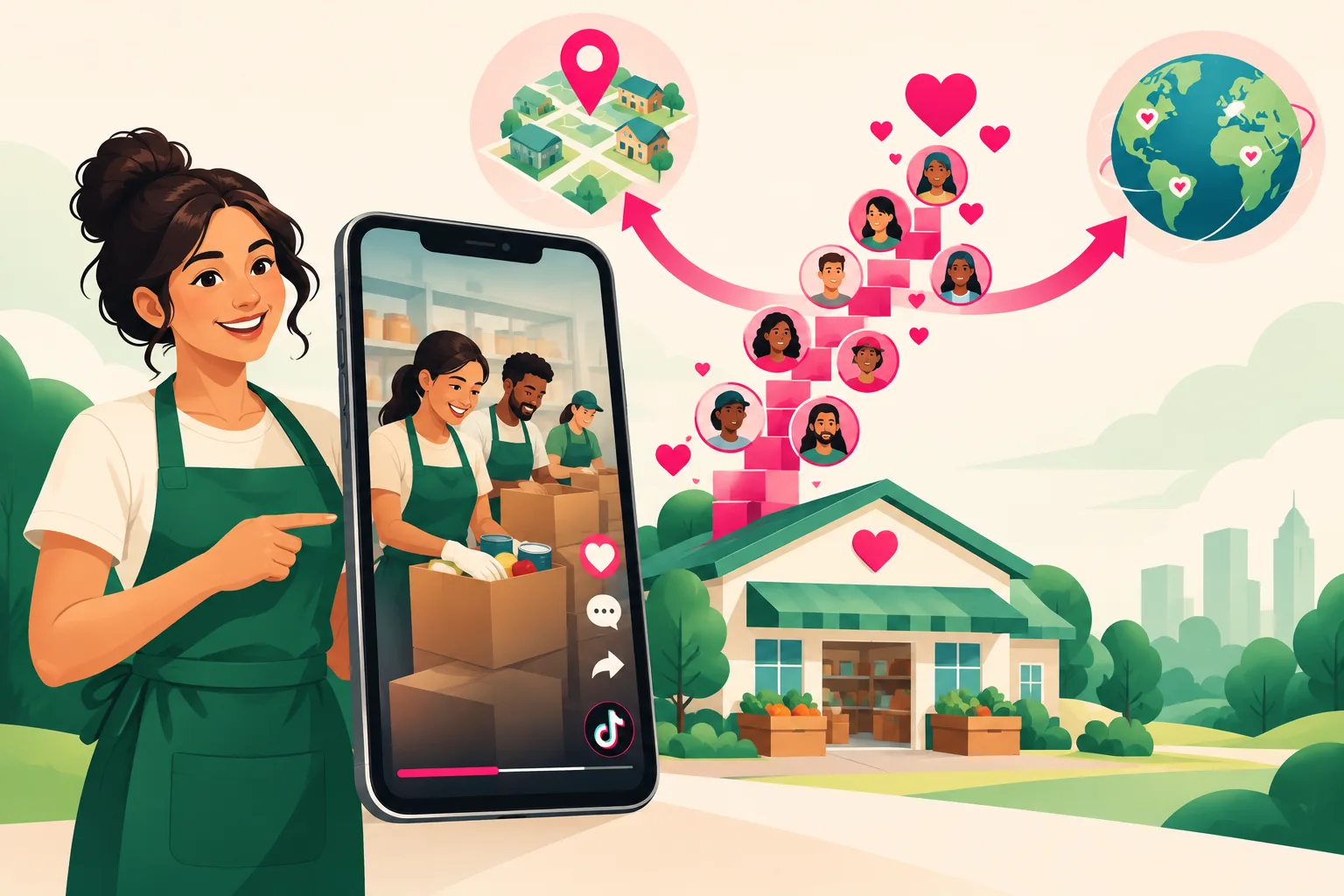
Because that is the thing about your sector that no other one on this platform shares: money travels, and hands don't. A gift can come from anywhere. A Saturday shift, a donated couch, an adoption, and a kid in the after-school program can only come from a drive radius. So a nonprofit account has two maps - and unlike the dentist or the vet two guides over, a national audience is not automatically a trap for you. It is a trap only if nobody asks it for anything and nobody can reach it twice. Every growth decision in this guide is downstream of that fact.
Meanwhile the economics on the other side of the trap are among the best we cover, for a reason that is usually described as the sector's biggest problem. Benchmarks have put first-time donor retention at roughly one in five for years: four of every five people who give once never give again, because the only things they ever receive are a tax receipt and another ask. A follower is a donor who can be thanked, shown exactly what their money did, and asked again - for free, forever. A few hundred of those out-raise a million scattered viewers, every December, for years. This guide is the roadmap to that audience, and beyond it to 100K for the organizations that choose the dollars path: the two scoreboards, the 90-day plan that finds your content engine, the series compounding that accelerates it, the growth signals that actually predict a funded program, and the point where selective amplification takes a proven account and points it at the right map ahead of GivingTuesday. It builds on our complete TikTok guide for nonprofits - if you haven't read that yet, start there for the strategy and compliance framework, then come back here for the growth mechanics.
The honest summary:
- Pick your scoreboard before you post. A hands-path account is measured in filled shifts and completed sign-ups from your drive radius. A dollars-path account is measured in second gifts and monthly donors from anywhere. Neither is measured in views or followers. One organization can run both, but only in a decided order.
- The 90-day plan has three phases: path, lane lock, and question-log mining (days 1-30), series compounding with a cast and one approver (days 31-60), and making it easy to act while riding the giving calendar (days 61-90) - ideally timed so the engine is warm by October.
- Saves on the receipt, email sign-ups, and the second gift predict a funded program. Views entertain; saves on the where-the-money-went video, profile taps, the list that grows with the follower count, and the donor who gives twice are what turn into a budget you can plan around.
- Growth you earn organically tells you which videos deserve promotion - amplify proof, not hope, and promote for followers, not one-time gifts.
What's Inside
- 1. Why Nonprofit Growth Is Different (Two Maps, Two Scoreboards)
- 2. The Foundation: Profile, Bio, the Pinned Trio & the Three-Button Page
- 3. Days 1-30: Path, Lane Lock & Question-Log Mining
- 4. Days 31-60: Series Compounding, the Cast & the One Approver
- 5. Days 61-90: Make It Easy to Act & Ride the Giving Calendar
- 6. The Growth Signals That Actually Matter
- 7. Milestones: What Changes at 1K, 5K, 10K & 100K
- 8. Breaking the Plateaus Every Nonprofit Account Hits
- 9. The Growth Mistakes That Stall Nonprofit Accounts
- 10. Accelerating Growth: Amplify Proof, Not Hope
- Frequently Asked Questions
1. Why Nonprofit Growth Is Different (Two Maps, Two Scoreboards)
Most growth advice on TikTok is written for entertainers who need scale, because their revenue is a thin slice of a huge audience. Most professional growth advice is written for people whose subject is boring, because their first job is making anyone care. You are in neither group, and that changes five things about how you grow:
- Your problem is the ask, not the audience. The lawyer and the accountant have to earn attention. You have to attach something to it. A video of real work being done - the truck unloading, the kennel getting cleaned, the box going from empty to full - is close to native currency on this platform, so the risk is never that nobody watches. It's that a million people watch, nobody is asked for anything, and nobody can be reached again.
- You have two legitimate maps, and you must pick the order. The vet and the dentist have radii. You have a showing-up map (local: shifts, in-kind gifts, adopters, event seats, the people who need the service) and a giving map (borderless: first gifts, second gifts, monthly donors, peer fundraisers), and they grow on different videos, different hooks, and different scoreboards. The pillar guide's section on the two paths lays them out. For growth purposes the rule is simple: the hybrid is real, but it is a sequence - most direct-service organizations fill the shifts first and build the giving audience second, and a disease charity or an environmental group may choose dollars on day one - and an account that never decides grows toward neither.
- Your conversion has a trust gate no other vertical has. A viewer can watch a lawyer once and call. Your viewer has to watch you enough times to believe that the money does what you say - "how much goes to overhead?" is the question under every gift not given - and that belief is built by repeated exposure to receipts, not by one viral hit. So growth in this vertical is measured less in how many people saw you once and more in how many people saw you report twelve times. The receipt that gets saved and rewatched is doing more for December than the clip that got a million views.
- A follower is worth more to you than to almost anyone on the platform. Not because of what they give the first time, but because of the sector's sorest number: roughly four in five first-time donors never give again. The mailer cannot thank them, show them the result, and ask again in January. A follower can be, for free. That makes the second gift - not the first - the real conversion, and it makes an audience the one retention tool a small organization can afford.
- You have a third audience, and it is watching the same feed. A direct-service organization's account is also seen by the people who need the pantry, the clinic, the shelter, or the class. The "what happens the first time you come in - no questions you are dreading" walk-through is a growth video and a program-access video at the same time, and the "I need help" message it generates deserves an answer in minutes. No other vertical grows an audience that includes its own clients.
So while "0 to 100K" is the headline, hold the real scoreboard in mind. For a hands-path organization, filled shifts start arriving in the low thousands of local followers. 100K is the dollars-path tier - the borderless giving audience, the peer fundraisers, the disclosed brand partnership - and we'll cover it honestly, including the version of 100K that is a warning sign rather than a trophy: a hundred thousand people and no list. Nobody should wait for it to consider this working.
2. The Foundation: Profile, Bio, the Pinned Trio & the Three-Button Page
Growth turns viewers into followers at exactly one place: your profile. A viewer finishes a video, taps your name, and decides in about three seconds whether to follow. Before posting anything, make those three seconds count - and make them point somewhere:
- The lane-plus-place-plus-ask bio. "Free groceries, no ID needed - East Tulsa - Tue & Thu 4-7 - volunteer, give, or get help below." The lane tells the algorithm and the viewer what you are; the place tells a local viewer you're reachable; the last line is the ask that "raising awareness" never includes. "We strengthen the community" is not a lane. "The rescue that takes the senior dogs nobody else will" or "the tutoring program that gets third-graders reading by June" is. If you've chosen the dollars path, the place becomes the cause named precisely and the ask becomes the monthly option - and the bio says so.
- A face, not a logo - and in your sector, the volunteer's face. People follow a specific kind human doing the work. They scroll past a logo and a "save the date" graphic. Your profile photo is a person who appears in the videos - the woman in the apron who has sorted donations every Saturday for nine years, not the executive director in a blazer; the organization name lives in the bio. Nonprofit accounts that grow are team accounts, so decide early who the recurring faces are - more on the cast in section 4.
- The pinned trio. Pin your best-performing cause correction (proof you understand the problem), the come-with-me shift or the how-to-get-help walk-through (the fear-remover that visibly cuts first-shift no-shows), and your receipt - the video that tells the person who has been wondering whether a small gift does anything "here is exactly what twenty dollars did last month." The third quietly converts more than the other two combined.
- The three-button page, one tap away, with the zip code asked first. A link-in-bio that opens a page with three plain buttons - give, volunteer, get help - never "DM us." The give button lands on a page with the monthly option visible, not hidden behind a checkbox. The volunteer form asks for the zip code at the top, before the name: it screens the four-time-zones sign-up politely, and it becomes your most honest hands-path metric. The get-help button goes to hours, what to bring, what not to worry about, and 211 - and if your address is confidential, it says how to reach you without giving it. Set the account up as a business account: in most regions that adds the website link without waiting for 1,000 followers and gives you TikTok's licensed music library for organization use.
- The email sign-up - the growth infrastructure most organizations never build. A follower is rented. A list is yours. Put a sign-up on the three-button page, ask for it in every thank-you, and treat sign-ups per video as a growth signal (section 6). It is the single thing that makes a viral spike survivable, because it is the only way to reach the three thousand people who gave five dollars once when January comes and you want to tell them what it did.
- The two forms, in the drawer before you need them. The story release for people you serve - separate from intake, specific to this use, revocable, never a condition of service - and the photo release printed on the volunteer sign-in sheet. Agreeing to receive help is not agreeing to be filmed, and a verbal "sure" at the door is not either. Print both now, so that by the time month two asks for a consented story you have a supply. The nonprofit filming guide's consent section has the form, the levels, and the edge cases.
3. Days 1-30: Path, Lane Lock & Question-Log Mining

One scheduling note before the plan: if you can choose when to start your 90 days, start in July or August, so the engine is running and the audience is warm when you build the receipt and the one story in October for the stretch between GivingTuesday and December 31. The engine works in any season - more on the timing lever in section 5.
The first month has three jobs, and none of them is going viral: choose your path, lock your lane, and build your question engine.
Choose the path first, in writing, at the top of your running note. Hands path: a drive-radius audience that shows up, drops off, adopts, and comes in for help. Dollars path: a borderless audience that gives, gives again, and fundraises for you. If the honest answer is "both," write the order too - for most direct-service organizations, hands first, dollars second - and which metric wins when the two collide. The algorithm is about to decide for you if you don't.
Lane lock means every video teaches the algorithm the same thing about who you are - and in month one, it's deciding exactly that from your first fifteen or twenty videos. This is the growth detail nonprofit accounts miss most: if those first twenty are cause explainers and statistics with no place in them, the algorithm files you as a cause account and serves you to cause-watchers everywhere - fine for the dollars path, fatal for the hands path. For a hands-path organization the opening month is deliberately anchor-heavy: shifts, walk-throughs, the truck route, a city said out loud, a neighborhood landmark in a sentence. For a dollars-path organization it is receipts and corrections with the cause named precisely. The national-reach travelers - the big corrections, the one story - come in month two, once your identity is set and they can lift an already-anchored account instead of defining an unanchored one.
Question mining is the habit that powers everything after, and yours has richer sources than anyone else's - and almost none of them involve the people you serve. The donor inbox: "how much goes to overhead," "is this tax-deductible," "can I give furniture," "why do you need money if the food is donated." Volunteer orientation: "can I bring my ten-year-old," "what do I wear," "will I be lifting things." The phone line, the board meeting, the comments. Everything administrative goes into a running note, verbatim and stripped of anything identifying - never a case detail, never a client's situation. Each one is a video with proven demand. In a normal week you'll bank 15-20. The asker's exact wording is your hook: open with their question, in their words, then answer it the way you would across the folding table. No introduction, no founding year, no mission statement - the question stops the scroll.
The month-one cadence:
- Post three answers a week, 30-60 seconds each, filmed on two program days a month - because footage only exists when the work happens - and designed for your worst week, not your best. The filming guide covers the kit bag under $75, the hours and angles where nobody you serve can appear, and how to film the work without faces so most of your library needs no release at all.
- Hook on the fix, never the pity. "Here's what twenty dollars did on Tuesday" grows an account. A crying child over sad music gets a view, strips dignity from the person in it, and trains the audience to scroll past your cause. This is the growth-correct move as well as the kind one: the solvable problem travels, and it is the hook a promoted video can use later. The pillar's hook section has the patterns.
- One person, not a statistic - and most weeks the "one" is not a person. One box from empty to full, one kennel, one route on the truck, one volunteer's first shift. A number is forgettable and a face needs a release; a box needs neither and converts better than both. The filming guide's section on filming the work shows how.
- Say the city out loud, or say the cause precisely. Hands path: "if you drive past the old Kmart on Harvard, we're behind it" - one spoken local reference per video, not just a hashtag, because local viewers stay longer on something that is visibly about their town. Dollars path: name the exact problem and the exact fix, every time, so the algorithm learns which cause-watchers to find.
- Tag lane and place every time. "#TulsaVolunteer #FoodPantry" - local viewers search, and the algorithm serves local content to local viewers.
- Reply to every comment, daily - five minutes between tasks. Each one is tomorrow's video and a signal that your account generates conversation. The "I need help" message gets the saved reply, in minutes: no appointment, no ID, the hours, what you'll leave with, and 211 for tonight. The "how much goes to overhead" comment gets a real number and a promise to show the receipt on the first of the month.
- Judge nothing before day 30. Early videos fluctuate wildly while the algorithm tests audiences. The data you need - which topics outperform, and where your followers actually live - only becomes readable with 12-20 videos posted.
4. Days 31-60: Series Compounding, the Cast & the One Approver
By day 30 you have data: a few videos clearly outran the rest. Month two is about turning those outliers into series - the single most underused growth lever in nonprofit content, and the one your sector is unusually well built for, because your best series comes with its own calendar.
Here's why they compound. A one-off video earns a view. A series - "Where your money went, month 4," "One box, start to finish, part 6," "Questions donors are too polite to ask, part 9" - earns a reason to follow. The viewer who watched month 4 follows so they don't miss month 5. Follows-per-view, the number that actually grows an account, jumps measurably the moment a numbered series appears. Series also feed binge-watching: a viewer who finds month 8 scrolls your profile to watch months 1 through 7, and that session of deep engagement tells the algorithm to show your account to more people like them. The monthly receipt is the most reliable series starter in nonprofit content: the month ends, the numbers exist, the episode ships, and every installment is also the answer to the question under every gift not given.
The month-two playbook:
- Promote your two best-performing topics into named series with a consistent on-screen title and numbering. Pair one traveler series (receipts, cause corrections - these reach nationally and serve the dollars path) with one anchor series (shifts, walk-throughs, the truck route - these fill the calendar locally). The ideas vault sorts every format this way; the growth rule is that the anchor series never gets dropped when the traveler series takes off.
- Give each series a host - this is the cast, and it is not the executive director. The lever unique to your sector: your cast is already there every Saturday. The volunteer who has sorted donations for nine years hosts the shift. The intake coordinator hosts the how-to-get-help walk-through, filmed in the empty room an hour before doors open. The development director hosts the receipt. The program lead hosts the correction. The executive director hosts the hard answer - the overhead question, the news-day explainer - once a month. Four voices means four hook styles being tested at once, so you find out faster which the algorithm and your city respond to, nobody burns out in week six, and it is quietly the recruiting content that reaches your next volunteer coordinator from the same footage. Everyone on camera has signed the release on the sign-in sheet.
- Name one approver. The committee plateau is the nonprofit-specific killer, and month two is when it strikes: a video that waits for the board meeting is a video that never ships, and a receipt that goes through four rounds of edits loses the plainness that made it work. Name one approver - the communications lead or the executive director, not both - with a one-page never-post list (the face of anyone served without a signed release, client files or sign-in sheets, a confidential address, anything about a candidate or an election, a number you cannot source) and a 24-hour turnaround. The board sees the account monthly; it does not review posts weekly. The pillar's cadence section has the approval rule in full.
- Turn your comment section into episodes. Use TikTok's video-reply feature to answer real comments on camera - the questioner shares it, the algorithm boosts the conversation loop, and you never run out. "Why do you need money if the food is donated" answered with the truck, the fuel, the walk-in fridge, and the two staff becomes one of your most-saved posts. Give the public half of the "I need help" reply on camera once - no appointment, no ID, the hours - and it becomes another.
- Switch on the consented story. The release has been in the drawer for a month, so you have a supply. The person who came for groceries in March and volunteers now, the dog that was here for nine months, the student who is reading - filmed with the specific written release signed on a calm day, by someone who does not decide their services, reviewed together before posting. Keep it to about one video in five; the boxes, the truck, and the volunteers carry the rest. The filming guide's section on people has the dignity rules.
- Watch completion rate above all. It's the dominant ranking signal. If a series' completion sags, the episodes are running long - nonprofits love context, and the founding story and the statistic kill completion. Tighten to 30-45 seconds, put the one essential number in the caption, and completion and reach recover. The TikTok algorithm guide breaks down the full signal hierarchy.
5. Days 61-90: Make It Easy to Act & Ride the Giving Calendar
Month three is deliberately boring: more of what the data says, less of everything else. This is where most nonprofit accounts fail - not from lack of ideas, but from novelty-chasing. Someone gets restless, abandons the series that was working for the trend of the week or the gala promotion, and resets the momentum. The accounts that reach five figures are the ones that kept shipping month 7 of the receipt when month 6 felt repetitive to them - because it never feels repetitive to the audience, most of whom just arrived.
- Scale the winners. If the receipts outperform, plan a where-the-money-went week. If one series drives most of your follows, take it to two episodes a week.
- Refresh your pinned trio with the best performers from the last 60 days - your profile should always lead with current proof.
- Check the map - and read it by path. Open your analytics and look at follower territories. For a hands-path organization this is the month it learns whether it is actually one: if the share of followers in your metro has fallen as reach rose, the traveler series is winning too hard - add local references to it and give the anchor series a second episode that week. For a dollars-path organization the map is almost irrelevant; check instead that the list grew with the follower count. Twenty thousand followers and forty email addresses is an account built on rented land.
- Switch on the asks - only now. Only now is it worth optimizing conversion, because only now do you have people to convert. The bio names the ask, the three-button page is live, the monthly option is visible, and the first ask is small and specific - "twenty dollars is a week of groceries for one household" only if that is true. Decide who thanks a new donor within 48 hours, by name, with a fifteen-second video saying what the gift will do this week. The pillar's supporter ladder shows where each rung breaks.
- Mine your analytics for the hero video. By day 90, one or two videos will have dramatically outrun everything: highest completion, most saves, most profile visits. Those are your amplification candidates - more on that in section 10.
- Ride the giving calendar - it's your biggest lever. Demand in your sector is the most calendar-driven of any we cover, and the biggest moment belongs to everyone at once: a large share of annual giving lands between GivingTuesday - December 1 in 2026 - and December 31, with a spike in the last three days. Publish each piece 30-60 days before its moment - the receipt and the one story in October, the "what your gift actually does" explainer in early November, the GivingTuesday video banked by mid-November, the December 30 "here is the match, here is the deadline" video filmed in advance, the thank-and-report in the first week of January, the first-shift walk-through in March for National Volunteer Week in April, the back-to-school drive in July - so your library is already surfaced and saved when someone suddenly wants to give. A receipt posted in October gets found on GivingTuesday; a receipt posted on December 28 competes with every organization in the country. The pillar's calendar section has the full year, including the news-day plan you decide before you need it.
6. The Growth Signals That Actually Matter
Views are the vanity metric of nonprofit TikTok - more so than in most niches, because a million views that fund nothing is just the awareness trap with a number on it. Seven signals actually predict whether an account is growing toward a funded program, and the seventh is one only a nonprofit can measure:
- Completion rate - the algorithm's favorite signal. Above 50% on a 40-second video means your hooks and pacing work; reach follows.
- Saves - especially on the receipt and the walk-through. A save on a cause correction means "I want to show my brother this." A save on the receipt means something rarer: "I'm going to watch this again before I give." A save on the how-to-get-help walk-through is someone deciding whether to come in. Track saves per video by format, and treat saves on the receipt in October as the leading indicator of December.
- Profile visits per video - the top of your supporter ladder. A video can get modest views but drive heavy profile traffic; that's a winner in disguise, because profile visits are one tap from your three-button page.
- Follows per view - your conversion rate from stranger to audience. When a specific topic or series doubles it, you've found your growth engine; feed it.
- Follower territory - read by path. TikTok's analytics show where your followers are. For a hands-path organization this single number is the difference between a volunteer pipeline and a hobby: a small account with most of its followers in-metro fills shifts; a huge account with a sliver in-metro does not. For a dollars-path organization, ignore the geography and watch the next signal instead. A national audience is not the trap in your sector - a national audience you cannot reach again is.
- Email sign-ups per video. The signal unique to an organization that knows a follower is rented. Count the sign-ups that arrive in the 48 hours after each post. When a format reliably produces them - usually the receipt and the one story - it is building the asset that makes the viral spike survivable and January's report possible.
- The second gift and the second shift. Open your donor database and your volunteer calendar, not your analytics, and count the donors who gave twice and the volunteers who came back, by month. The mailer and the gala never reach the person who watched twelve receipts and then gave again - only the account that made the money visible does. When those counts rise, and when they cluster in the weeks after you post a receipt or a thank-you, your content is doing the one thing in this sector that nothing else can. It is the most honest growth metric a nonprofit has. Counts, never names, and the donor data stays in your database, not in the DMs.
Notice what's not on the list: likes (cheap), shares (genuinely valuable here - "send this to your coworker who keeps saying she wants to volunteer" is how nonprofit content spreads - but erratic), DM volume (the number that goes up fastest in the awareness trap, and the one to ignore), raw follower count (the output, not the input), and the viral video's one-day gift total (which is real money and a false signal if nobody gave twice). Check these seven weekly, in TikTok's built-in analytics and your donor database, and let them - not your feelings about a video, and not the board member who wants another gala graphic - decide what you make next.
7. Milestones: What Changes at 1K, 5K, 10K & 100K

Growth isn't linear, and each tier unlocks something different. Here's the honest map, written for the hands path with the dollars path noted where it diverges:
- 0-1,000: the proving ground. The slowest stretch for most professions, and often a quick one for you - work-being-done content gets tested on a willing audience immediately. Typical timeline with three posts a week: 45-90 days. The unlock at 1K for a personal account is the link-in-bio; a business account has it already, so the real unlock is enough data to read your map. The warning at 1K comes in two versions: a hands-path account whose thousand are already spread across the country, which needs its anchors fixed now while it is small enough to steer, and a dollars-path account with a thousand followers and no list, which needs its page fixed before anything else.
- 1,000-5,000: the first shifts and the first gifts. If your content is lane-focused and place-anchored, this is where "I found you on TikTok" starts appearing on the volunteer form with a zip code you serve. First gifts arrive later and lumpier - the person who followed in August gives on December 30, and that lag is normal, not failure. Here the retention math takes over: a sliver of a few thousand followers giving twice doesn't just cover the effort of posting - a handful of monthly donors from this tier is income you can plan a program around, and it keeps paying for years.
- 5,000-10,000: the cause your city thinks of. Volunteers arrive pre-sold - they've watched the shift three times and know where to park, which changes the tone of the first morning, cuts first-shift no-shows, and, coordinators consistently report, turns one-time volunteers into regulars. In-kind offers start arriving faster than you can store them - say no to the furniture, kindly, in a video. A reporter calls. The board stops asking why you are on TikTok and starts asking what to post. For a hands-path organization, this tier is the entire game won: a reliable, essentially free pipeline of people who show up that the flyer and the gala never produced.
- 10,000-100,000: the dollars tier - and the trap that looks like it. Growth past 10K increasingly comes from viewers outside your radius, which stops adding shifts but starts adding a different asset, and this is where your sector diverges from every practice in this series: for you, that asset is legitimate. The donor in another state who watches every receipt, the birthday fundraiser from someone who has never seen your building, the disclosed partnership with a brand that fits the cause, the matching gift from a company that found you in the feed. Push toward 100K if you want those, and build the list, the monthly program, the 48-hour thank-you capacity, and your charitable solicitation registrations - many states require them before you ask their residents for money - before you arrive. But treat 100K with sixty email addresses and a volunteer calendar full of holes as a trap you fell into, not a milestone you reached - unless you chose the dollars path on day one and built the list on the way.
The strategic takeaway: optimize for the 1K-10K tiers first. That's where the retention economics live - and where a supporter who gives every month for years, shows up twice a year with their kids, and runs a birthday fundraiser makes every milestone worth more than it would be in most niches. 100K is a legitimate goal for the dollars-path organization - and the playbook is the same engine, run longer, with amplification widening the audience beyond your radius on purpose and the list growing underneath it.
8. Breaking the Plateaus Every Nonprofit Account Hits
Every growing account stalls somewhere. Nonprofit accounts stall in predictable places, with predictable fixes:
- The awareness plateau. Reach is up, followers are up, the comments are full of "this is so important," and the program budget is flat. This is the nonprofit plateau - it looks like success, which is why it lasts so long. Nobody was ever asked for anything. Fix: the three-button page, the ask in the bio, the receipt re-pinned, the monthly option visible, and one small, specific ask per month that names what the money does. The audience will not leave; it will finally have something to do.
- The viral-spike plateau. One video went huge, three thousand people gave five dollars, and three months later not one of them has given again. The spike was real money and a false signal. Fix - and have it ready before the spike: a fifteen-second thank-you video the same week, specific to that wave ("you funded the walk-in fridge - here it is"), the email capture on the donation page so the wave can be reached, the January report to the list showing what the money did, and the second ask tied to the receipt rather than to another emergency. A spike with a list behind it is a donor base. A spike without one is a story you tell at the board retreat.
- The committee plateau. Posting slowed to nothing because every video needed sign-off from four people and the receipt was still in edits on the fifteenth. Fix: one approver, the one-page never-post list, a 24-hour turnaround, and the board reviewing the account monthly instead of the posts weekly. The post that waits for the meeting never happens.
- The pity-hook plateau. A suffering face over sad music went big, and then the comments turned angry, follows flattened, and - the part nobody connects - fewer people came in for help, because the people you serve saw how you show them. Fix: rebuild the hooks on the fix and the viewer's part in it, re-pin the walk-through that promises nobody makes it awkward, and if a person was shown without a real yes, take it down and say so.
- The flyer plateau. The feed became event graphics, gala photos, and sponsor thank-yous, and follows stopped because there was nothing to follow for. Fix: show the work. The gala becomes a twenty-second clip of what the gala funded; the event flyer becomes the volunteer walking the route the morning of.
- The capacity plateau. The account grew beautifully on one person, then a grant deadline, a staff departure, a crisis week - and posting stopped for eight weeks. Fix: the cast. A bank of evergreen explainers from the program-day batch, the volunteer hosting her series, the development director posting the receipt, and permission to drop to two a week without apologizing. Three sustained beats seven in a good month and zero in a bad one, every time.
- The consent plateau. Posting slowed because every idea seemed to need a person you serve and the release felt like a hurdle. Fix: the engine was never supposed to run on the people you serve. The boxes, the truck, the kennel, the volunteers, the question log, and the myth on your own feed carry four videos in five; the consented story is the fifth. The filming guide's work-without-faces section shows how to make a month of content with no one served in frame.
- The same-audience plateau. Reach flatlines because the algorithm has shown you to everyone in your immediate interest pocket. Fix: adjacent-topic expansion that stays credibly in your lane. A pantry adds a "how to stretch a week of groceries" series; a shelter adds senior-dog care; a tutoring program adds "how to read with your kid in ten minutes"; a land trust adds the creek-walk explainer. Adjacent lanes reach new pockets while deepening the trust the receipt built.
- The fear plateau. Someone said "501(c)(3)" and "the board" in the same sentence, and you stopped posting anything with substance. Fix: the rules are narrower than the fear. A receipt, a correction, or a walk-through uses no client information and endorses no candidate - which is exactly what makes it the safest lane in this sector. The release for anyone served on camera, no candidate or election content, honest numbers, honoring what the ask said the money was for, and your solicitation registrations keep you compliant; the pillar guide's compliance section walks through exactly where the lines are. Substance grows the account; vagueness is what the regulator and the algorithm both ignore.
9. The Growth Mistakes That Stall Nonprofit Accounts
- Opening with the organization's name and founding year. "Hi, we're the East Side Community Foundation, serving families since 1987, and today..." is an exit ramp. One person and one solvable problem is the hook; your name belongs in your bio and your credibility in the receipt.
- Posting announcements instead of answers. The "save the date" graphic, the sponsor thank-you, the stock photo of hands holding a seedling - your existing supporters mildly care; the algorithm's audience doesn't. Every video should answer something a stranger has actually wondered about your cause, your city, or where the money goes.
- Asking in every video - or never asking. Both end the same way. An account that is all asks trains the audience to scroll past; an account that never asks is the awareness trap. The rhythm that works is most videos with no ask at all, one small specific ask a month, and the receipt that makes the next ask easy.
- Never saying where you are. The single most expensive omission for a hands-path organization, because your content travels so well by default. A perfect come-with-me shift with no city in it fills nobody's Saturday. One spoken local reference per video is the cheapest targeting that exists.
- Deleting slow videos. Nonprofit videos surge on the calendar's schedule, not the posting date - the GivingTuesday explainer posted in a quiet March wakes up every November for years, and the first-shift walk-through wakes up every January. Old videos become binge material when a new viewer discovers your profile. Deletions erase the algorithm's learning. Leave the catalog alone.
- Chasing trends outside your lane - especially in an election season. The staff doing the trend of the week isn't a strategy; it's lane noise. And the trend that attaches your cause to a candidate or a ballot measure is not lane noise, it is a tax-status problem: a 501(c)(3) may not support or oppose candidates, and lobbying is limited. Use a trend only when your expertise genuinely fits it - reacting to a viral myth about your cause is in-lane; a political sound is not.
- Doing casework in the DMs. "I need food and I don't know what to do" deserves an answer in minutes, and a DM is not the place to triage it. The saved reply - no appointment, no ID, the hours, what you'll leave with, 211 for tonight - is both the humane move and the growth-correct one, because the public version becomes one of your most-saved videos.
- Filming the line without the release. A single person who sees themselves at your intake desk without having said yes is a reputational hit in exactly the community you serve, and a reason for the next person not to come in. The release in the drawer costs nothing, and the box needs none. The filming guide's what-not-to-show list has the full set, including the drive-through plates and the exterior of a confidential site.
- The "donate to enter" giveaway. A raffle as the growth strategy attracts the entrant, not the donor, teaches the algorithm you are a contest rather than a cause, and in most states a chance to win in exchange for a donation is regulated gaming that needs a license or is not allowed at all. The receipt fills more Decembers than the prize ever will.
- Running the account from a volunteer's personal phone. The login leaves when they do, and so does every video. The account is registered to an organization email with a password the organization controls, footage never stays on a personal device, and what happens to the videos when someone leaves is written down before anyone is on camera.
- Buying followers. Bots never give, never show up, and their dead engagement teaches the algorithm to bury you with real supporters. A padded count is exactly the kind of misleading representation state charity regulators police, and a donor who finds out is a donor you have lost along with everyone they tell. There is no shortcut here that works - only the amplification of real, proven content.
10. Accelerating Growth: Amplify Proof, Not Hope
Run the 90-day engine and something predictable happens: one or two videos dramatically outperform everything else. Completion high, saves stacking, profile visits spiking. Those videos have already passed the only test that matters - real strangers watched to the end and trusted you more afterward.
That's the moment paid promotion stops being a gamble. Amplifying an unproven video is hope; amplifying your hero video is arithmetic - and nonprofit arithmetic is unusual in three ways. First, the payback is measured in retained supporters, not a sale, which changes what you promote for: promote for followers and list sign-ups, not for one-time gifts. A stranger who gives five dollars from a promoted video and never follows is the viral spike with an invoice attached; a stranger who follows can be thanked, shown the receipt, and asked in December, so the break-even is a fraction of a single second gift and the right metric is cost per retained donor or per completed sign-up.
Second, the targeting solves the two-maps problem: promoted reach goes exactly where you point it, which is the one thing the organic algorithm will never do for you. Point the come-with-me shift and the walk-through at the metro, drawn tightly, and point the receipt and the one story at the wider audience that shares the cause - never the other way around. Third, the timing lever is real: promoting the proven receipt in late October and November, while people are quietly deciding what to give this year, costs a fraction of competing in December when every retailer in the country bids for the same person. Amplify before GivingTuesday, not during the last week, and December's donors arrive already trusting you. The same logic runs the thank-and-report in January, the cheapest month to buy attention and the one where retention is decided.
That's exactly the model behind our TikTok promotion service: selective amplification of the videos that already earned it, targeted to the map you chose, timed to run ahead of your moment. Promoted nonprofit content still has to follow your rules, and a few are stricter in a paid placement than in an organic one: TikTok prohibits political advertising and, in most markets, issue-based advertising, and routes nonprofit advertisers through its own approval process - so a video about the work itself usually clears and a video about legislation may not, and you should expect to document your status before you promote; a promoted video is a wider disclosure than an organic post, so the story release of anyone served on camera should have a separate checkbox for paid use - consent to post is not consent to promote; a promoted video that asks residents of other states for money is a solicitation in those states; and every ad dollar is a donor's dollar, so measure it, report it to the board like any program expense, and stop when the cost per retained supporter says to.
Which is one more reason the fix-not-pity hook wins: it is the hook a promoted video can use. Amplify the receipt, not the pitch. For growth toward the 100K dollars tier, the same approach deliberately widens the targeting beyond your radius. For the mechanics of promoting through TikTok's native tools, see the Spark Ads guide; for the local-discovery mechanics that help any organization serving a drive radius, the local business TikTok marketing guide; and for the broader organic playbook this plugs into, the ultimate TikTok growth guide covers the cross-niche fundamentals.
Frequently Asked Questions
How long does it take a nonprofit TikTok account to grow?
Faster than most professional accounts, because the platform already likes causes: a video that shows real work being done, with one person and one solvable problem in it, gets tested on a willing audience immediately. With three videos a week filmed on program days, most organizations see their first outlier video inside 30 days, cross 1,000 followers in 45-90 days, and reach five figures within a year. The more useful timeline is the supporter one. Organizations on the hands path typically report their first "I found you on TikTok" volunteer sign-up between 1,000 and 5,000 local followers. First gifts arrive later and lumpier, clustered around GivingTuesday and the last days of December rather than spread evenly across the year, so a follower gained in August often becomes a donor on December 30.
How many TikTok followers does a nonprofit need to get donors and volunteers?
Far fewer than the follower count suggests, as long as they are the right followers for the path you chose. On the hands path, a few hundred people inside your drive radius who have watched the come-with-me shift three times fill Saturday mornings and bring their coworkers; the number that matters is the share of your followers who could physically reach you, which TikTok shows in the follower-territory breakdown, and the sign-ups that arrive with a zip code you serve. On the dollars path, geography barely matters and the number that matters is the list: a thousand followers who have watched twelve monthly receipts and joined your email list out-raise fifty thousand who watched one viral video and were never asked again, because the second gift, not the first, is where nonprofit economics live.
Why is my nonprofit TikTok getting views but no donations?
You are in the awareness trap: the content is working and nothing is attached to it. Check three things in order. First, the ask: a bio that names what you do, where, and the next step, and a link that opens a page with three plain buttons (give, volunteer, get help) with the monthly option visible. Second, the proof: pin a receipt, the video that says exactly what last month's gifts did line by line, because the question under every gift not given is where the money goes. Third, the list: an email sign-up on the page and in every thank-you, so the people you reached once can be reached again when the moment arrives. If all three exist and gifts still have not come, look at the calendar before you look at the content. Giving is lumpy and lands at year-end, so a quiet October with growing saves on the receipt is usually a December that is about to work.
Should a nonprofit buy TikTok followers?
No. Purchased followers are bots and dead accounts that will never give, show up, or share, and they actively hurt you: they crater your engagement rate, which tells the algorithm your content is weak, so real reach to real supporters drops. A padded count is also the kind of misleading representation that state charity regulators and attorneys general take seriously, and a donor who finds out is a donor you have lost along with everyone they tell. The legitimate way to accelerate is the opposite: promote a video that has already proven itself with real viewers, targeted to the map you chose, so the followers you gain are people who could become volunteers and second-time donors.
When is the best time of year to start a nonprofit TikTok?
Start your 90 days in July or August, so the engine is running and the audience is warm when you build the receipt and the one story in October for the stretch between GivingTuesday (December 1 in 2026) and December 31 - the largest predictable giving moment of the nonprofit year, with a spike in the last three days. The account works in any season because the nonprofit calendar gives you a reason to post every month, so if it is spring, start now with volunteer-week shifts and plan the summer batching. If it is already October, it is not too late: post the receipt this week, build toward GivingTuesday with no ask until mid-November, thank every December donor within 48 hours, and report back in January. If it is already December, post the "what your gift does" explainer, reply to every comment, and block July on your calendar.
Who should run and own the nonprofit TikTok account?
The organization owns it and the volunteers and frontline staff are the faces. Viewers follow a specific, kind human doing the work and scroll past a logo, and the person they most want to see is rarely the executive director: it is the Saturday volunteer who has sorted donations for nine years, the kennel tech, the tutor, the intake coordinator walking an empty room. Register the account to an organization email with a password the organization controls, keep footage off personal phones, put a photo release on the volunteer sign-in sheet, and write down what happens to the videos when someone leaves. Then name one approver, not a committee, with a one-page never-post list and a 24-hour turnaround. The board sees the account monthly; it does not review posts weekly.
Found the receipt your supporters already trust?
The 90-day engine finds your winners - amplification decides how many future supporters see them, where, and when. Viryze promotes the videos that have already proved themselves, putting your best receipt or walk-through in front of thousands more people who can show up or give, on the map you chose, before GivingTuesday lands - so the trust you've built converts into followers who can be thanked, second gifts, and monthly donors who stay for years.
Grow your organization's account fasterRelated Reading
- TikTok for Nonprofits: The Complete 2026 Guide - the full strategy and compliance framework this growth roadmap plugs into.
- Nonprofit TikTok Content Ideas: 50+ Video Concepts That Win Donors and Volunteers - the vault, sorted into travelers and anchors, that keeps the 90-day engine fed.
- How to Film Nonprofit Content for TikTok (Consent, Dignity & What Never to Show) - the consent-first production system behind the program-day batch.
- Growing a Dentist TikTok: From 0 to 100K Followers - the closest parallel: another account with two legitimate targets and two scoreboards.
- Growing a Vet Clinic TikTok: From 0 to 100K Followers - the drive-radius growth model for a local organization whose subject the platform already loves.
- Understanding TikTok's Algorithm: What Really Matters - the signal hierarchy behind every recommendation in this roadmap.

Head of Creator Success at Viryze
TikTok growth strategist helping creators reach their first 100K followers through data-driven promotion strategies.