You have a great product. You know it works. But your TikTok product videos get 200 views and zero sales. Sound familiar? The problem isn't your product—it's how you're filming it.
Here's the reality: the difference between a product video that flops and one that drives thousands in sales comes down to a handful of filming techniques. Techniques that cost $0 and require nothing more than your smartphone. E-commerce brands that nail their product videos on TikTok are seeing conversion rates 2-5x higher than any other social platform.
In this step-by-step guide, you'll learn exactly how to set up your filming space, choose the right video formats for your products, hook viewers in the first 3 seconds, and edit for maximum sales impact. Whether you sell skincare, kitchen gadgets, fashion, or handmade goods—these are the proven formulas that turn scrollers into buyers.
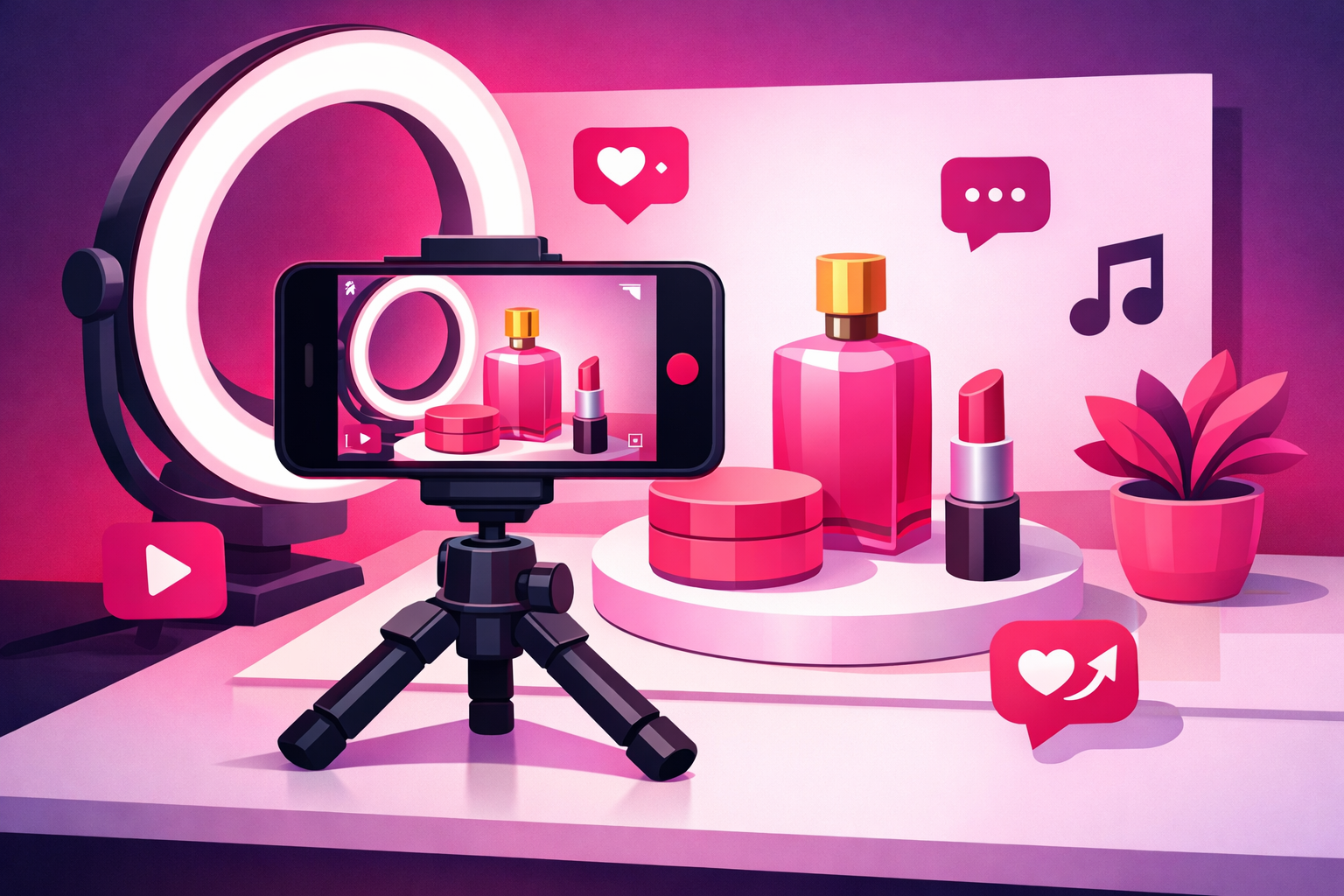
Table of Contents
The Essential Filming Setup (Under $50)
Let's kill the biggest myth right now: you do not need expensive equipment to film TikTok product videos that sell. The most successful e-commerce accounts on TikTok film everything on their phones. What matters is your setup—not your gear.
From our experience analyzing thousands of top-performing product videos, accounts that invest just 15 minutes setting up a proper filming space see a 40% increase in average watch time compared to those who just point and shoot.
Your Starter Kit (Total: $30-50)
Smartphone
Any phone from the last 3-4 years works. iPhone 12+ or Samsung Galaxy S21+ are ideal, but anything with a decent camera will do. Film in 1080p at minimum—4K if your phone supports it.
Mini Tripod ($10-20)
A stable shot looks 10x more professional than a shaky handheld video. A flexible mini tripod with a phone clip is all you need. Bonus: it frees up both hands for product demos.
Ring Light ($15-25)
This is the single biggest upgrade for product videos. A basic 10-inch ring light eliminates harsh shadows and makes products look clean and professional. Position it directly in front of your product at a 45-degree angle.
Clean Background ($0-5)
A plain white poster board, a clean marble countertop, or even a simple bedsheet works. The background should never distract from your product. When in doubt, go minimal.
The Setup That Outsells Studios
One of the highest-converting e-commerce TikTok accounts we've studied films every product video on a kitchen counter with a $15 ring light and an iPhone 13. Their average video drives $800+ in daily sales. The secret? Consistency in setup and mastering the video formats below.
7 TikTok Product Video Formats That Sell
Not every product video format works equally well. After studying the top e-commerce creators, we've identified what we call The Product Video Playbook™—seven proven formats that consistently convert viewers into customers.
The key? Match the format to your product's strongest selling point. A gadget that solves a problem needs a different format than a fashion piece that looks amazing when worn.
1. The Problem-Solution Demo (Highest Converting)
Start by showing a frustrating problem, then reveal your product as the hero. This format has the highest conversion rate because it creates an emotional need before the viewer even sees the product.
Example: Show tangled jewelry, then your magnetic jewelry organizer snapping everything into place in 2 seconds.
Best for: Gadgets, cleaning products, organizers, tools, beauty devices.
2. The Satisfying Unboxing
Film the entire experience of opening your product. The anticipation, the tissue paper peeling, the reveal—it's inherently addictive to watch. Add ASMR-style sound for extra engagement.
Example: Hands slowly unwrapping premium packaging, revealing a beautiful skincare set with a satisfying snap of the box closure.
Best for: Premium products, gift items, subscription boxes, anything with beautiful packaging.
3. The Before/After Transformation
Show the dramatic change your product creates. Use a split-screen or quick cut between "before" and "after." The more dramatic the difference, the more shares you'll get.
Example: A messy, stained countertop → one wipe with your cleaning product → sparkling clean surface.
Best for: Cleaning supplies, beauty products, home improvement, fitness equipment.
4. The "Day in My Life" Integration
Weave your product naturally into a day-in-the-life video. This doesn't feel like an ad, so viewers don't scroll past. They see your product in context, which makes it feel attainable and necessary.
Example: Morning routine showing your coffee mug warmer keeping coffee hot throughout the busy morning.
Best for: Lifestyle products, fashion, kitchen items, home decor.
5. The Side-by-Side Comparison
Compare your product against a well-known alternative (or a generic version). Show why yours is better. This works especially well if your product has a clear visual advantage.
Example: Your insulated water bottle keeping ice for 24 hours vs. a regular bottle where ice melts in 2 hours.
Best for: Products with measurable superiority, tech gadgets, kitchen tools, fitness gear.
6. The Customer Reaction Montage
Compile real customer reactions, UGC (user-generated content), and review clips into a rapid montage. Nothing sells like seeing other real people loving your product.
Example: Quick cuts of 5-6 different customers opening your product, reacting positively, with their review comments overlaid.
Best for: Any product with existing customers, subscription services, viral products.
7. The "I Found This on TikTok" Review
Create a first-person, authentic-feeling review as if you discovered the product on TikTok. This format leverages the trust that comes with peer recommendations over brand messaging.
Example: "OK so TikTok convinced me to try this thing and I'm honestly obsessed..." followed by a genuine-seeming product demo.
Best for: Trending products, beauty items, novelty gadgets, food products.
The 3-Second Hook: Stop the Scroll
Every product video lives or dies in its first 3 seconds. This is what we call The Scroll-Stop Window™—the tiny moment where a viewer decides to keep watching or swipe to the next video.
Our data shows that product videos with a strong visual hook in the first 3 seconds have a 60% higher completion rate than those that start slowly. And completion rate directly impacts how many people the TikTok algorithm shows your video to.
5 Proven Product Video Hooks
- The Action Start—Begin mid-action. Show the product already doing something impressive. Never start with a static product sitting on a table.
- The Unexpected Reveal—Start with something ordinary, then reveal the product in a surprising way. "This $12 gadget replaced my $300 kitchen appliance."
- The Question Hook—Open with a question your target buyer relates to. "Why is your skincare routine not working?" Then show your product as the answer.
- The Visual Contrast—Show an ugly "before" state in the first frame. Viewers stay to see the transformation.
- The Curiosity Gap—Show an intriguing result without revealing how it happened. "Watch how I cleaned this in 10 seconds." The viewer must keep watching to find out.
Pro Tip: The Mute Test
85% of TikTok videos are initially watched without sound. Film your hook so it works completely silently. If your first 3 seconds don't grab attention on mute, you've already lost. Once you find a hook that stops the scroll, use a TikTok promotion service like Viryze to amplify it to thousands of potential buyers.
Lighting and Angles That Make Products Pop
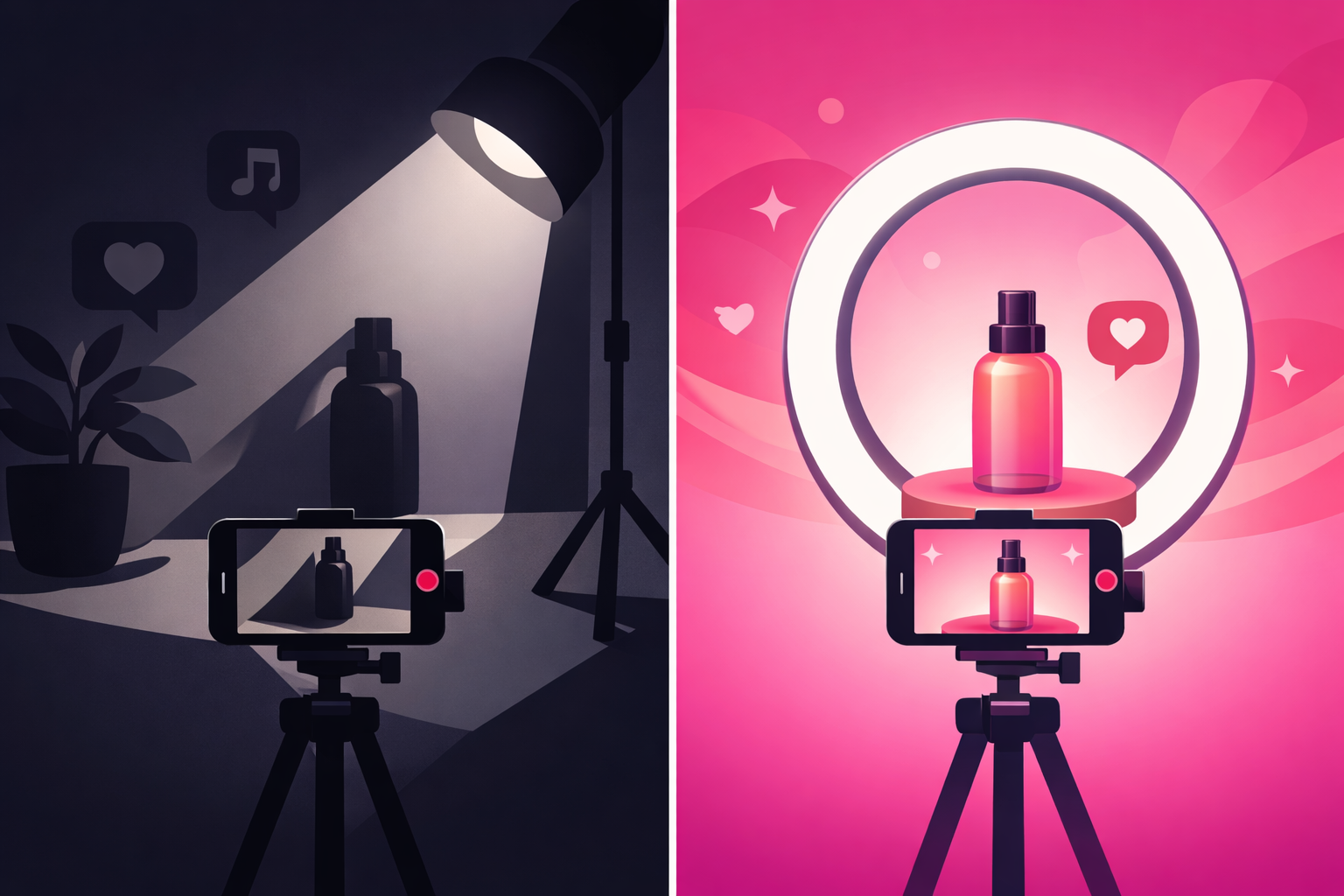
Lighting is the single biggest difference between product videos that look amateur and ones that look professional. Good news: you don't need a studio. You just need to understand two simple principles.
The Two Lighting Rules for TikTok Product Videos
Rule 1: Front-Facing, Soft Light
Position your light source directly in front of the product (or slightly above at 45 degrees). This eliminates harsh shadows that make products look cheap. A ring light is perfect for this. If using natural light, face a window—never have a window behind you.
Rule 2: Consistent White Balance
Lock your phone's white balance before filming. Mixing warm indoor light with cool daylight makes products look different in every shot. On iPhone, tap and hold to lock exposure. On Android, use Pro mode. This ensures your product color looks accurate and consistent.
Camera Angles That Sell
Different angles tell different stories. Use these intentionally based on what you want the viewer to feel:
- ✓Top-down (bird's eye)—Best for flat-lay product arrangements, food, skincare routines, desk setups. Creates an organized, aspirational feeling.
- ✓Eye-level straight on—Best for product comparisons, demonstrations, and anything you want to feel like a peer recommendation.
- ✓Low angle (looking up)—Makes products look premium and important. Great for bottles, electronics, shoes.
- ✓Close-up detail shots—Show texture, quality, craftsmanship. Viewers who see close-ups are 35% more likely to trust the product quality.
- ✓POV (point of view)—Film as if the viewer is using the product themselves. This creates a sense of ownership before they even buy.
The Multi-Angle Method™
The highest-performing product videos use 3-5 different angles within a single video. Film your product from multiple positions during one session, then cut between them quickly in your edit. This keeps the viewer engaged and shows the product from every perspective—like turning it around in their hands. Combine this with understanding TikTok ad creative best practices for maximum impact.
Editing Your Product Videos for Conversions
Great filming is only half the battle. How you edit your product videos determines whether viewers watch to the end (and buy) or drop off halfway through. Here's the editing formula that drives sales.
The 4-Beat Edit Structure
Every high-converting product video follows this rhythm:
- Hook (0-3 seconds)—Grab attention with a visual punch. No logos, no introductions—just action.
- Demo (3-20 seconds)—Show the product in use. Multiple quick cuts between angles. Each clip should be 2-4 seconds long.
- Payoff (20-35 seconds)—The satisfying result. The clean surface, the organized drawer, the perfect outfit. This is the "money shot."
- CTA (35-45 seconds)—A quick call-to-action. "Link in bio" or "Shop now in TikTok Shop." Keep it to 2-3 seconds max.
Editing Must-Dos
- ✓Add on-screen text captions—Since most viewers watch muted, text conveys your message visually. Highlight the product name, price, and key benefit.
- ✓Use trending audio—Products paired with trending sounds get up to 30% more distribution from the algorithm. Check TikTok's Creative Center for what's trending now.
- ✓Quick cuts every 2-4 seconds—Keep the visual pace fast. Slow, lingering shots cause viewers to drop off. Every cut should show something new or a different angle.
- ✓Film vertically (9:16)—Always shoot in portrait mode for TikTok's full-screen format. Landscape videos look amateur and waste screen space.
- ✓Loop the ending—Make the last frame connect back to the first. This encourages repeat watches, which signals the algorithm to boost your reach.
Scaling Your Winners With Advertising
Once you've filmed a product video that converts organically, you've struck gold. The next step is pouring fuel on the fire. A single product video that drives 50 organic sales can drive 5,000+ when you put ad spend behind it.
The Organic-to-Paid Playbook
- Post 5-10 product videos organically—Test different hooks, formats, and angles from this guide.
- Identify your winners—Look for videos with above-average watch time, saves, and comments asking "where can I buy this?"
- Turn winners into Spark Ads— Spark Ads boost your existing organic post while keeping all the engagement and social proof.
- Test audience segments—Start with $20-50/day testing different demographics, interests, and behaviors. Understand the cost structure of TikTok ads before scaling.
- Scale profitable combinations—Once you find an audience + creative combo with profitable ROAS, increase your daily budget gradually.
Skip the Ad Manager Learning Curve
TikTok Ads Manager is powerful but complex. Instead of spending weeks learning audience targeting and bid strategies, Viryze's professional TikTok advertising tests multiple audience segments automatically and shifts your budget to whichever combination drives the most sales. It's how e-commerce brands scale their product videos without hiring a media buyer. Learn more about TikTok Ads vs. Promote to understand your options.
Product Video Ad Budgeting
- Testing phase ($20-50/day): Run 3-5 different product video variations for 5-7 days to find which hooks and formats resonate.
- Validation phase ($50-100/day): Focus budget on your top 1-2 performers. Track your return on ad spend (ROAS) closely.
- Scale phase ($100-500+/day): When a product video consistently drives profitable sales, increase budget 20% every 2-3 days.
Product Video Mistakes That Kill Sales
Even great products fail on TikTok when filmed the wrong way. Here are the mistakes we've seen cost e-commerce brands the most sales—and how to avoid each one.
Starting With a Logo or Brand Intro
Nobody cares about your brand name in the first frame. They care about what your product does for them. Save the branding for the end. Every second of logo screen is a second viewers are swiping away.
Filming Horizontally
Landscape videos with black bars above and below are an immediate credibility killer on TikTok. Always film in portrait mode (9:16). This seems basic, but we still see established brands making this mistake daily.
Over-Produced "Commercial" Style
TikTok users scroll past content that looks like a traditional ad. The platform rewards authenticity. A creator showing your product at their kitchen table outperforms a studio-produced commercial. Embrace the casual, genuine feel.
No Call-to-Action
You just made them want your product—now tell them how to get it. Even a simple "Link in bio" or "Available in TikTok Shop" at the end converts significantly more than no CTA. Don't assume viewers will figure it out.
Only Posting One Video Format
Your audience has different preferences. Some respond to unboxings, others to problem-solution demos. Test multiple formats from our Product Video Playbook above. Track which drives the most sales, not just views—then double down on winners.
Frequently Asked Questions
What equipment do I need to film TikTok product videos?
At minimum, you need a smartphone with a decent camera (iPhone 12+ or equivalent), a small tripod or phone holder ($10-20), and a ring light or window with natural light. As you scale, consider adding a wireless microphone ($30-50) and a simple backdrop. You do not need expensive camera equipment—authenticity outperforms polish on TikTok.
How long should TikTok product videos be?
The sweet spot for product videos that convert is 15-45 seconds. Quick demos and reveals perform best at 15-20 seconds, while detailed tutorials and comparisons work well at 30-45 seconds. Videos over 60 seconds tend to lose viewers before the call to action.
How many product videos should I post per day?
For e-commerce accounts, posting 1-3 product videos per day is ideal. Batch-film 5-10 videos in one session to save time, then schedule them throughout the week. Each video is a chance for the algorithm to push your content to potential buyers. Consistency matters more than perfection.
Do polished product videos perform better than casual ones?
No. On TikTok, authentic and casual product videos consistently outperform studio-polished content. Users trust real people using real products in real settings. A genuine smartphone review at a kitchen table outperforms a $10,000 commercial. Focus on good lighting and clear demonstrations rather than Hollywood production value.
What types of products sell best through TikTok videos?
Products that are visually demonstrable sell best: items that produce a satisfying result, solve an obvious problem, or have a wow factor on camera. Top categories include beauty, kitchen gadgets, home organization, fashion accessories, and fitness equipment. Price points between $15-75 convert best for impulse purchases. If you can show your product doing something impressive, it can sell on TikTok.
Ready to Turn Your Product Videos Into a Sales Machine?
Start with the filming setup and video formats in this guide. Once you find a product video that converts, scale it to thousands of potential buyers with Viryze's TikTok promotion service. We automatically test multiple audience segments and optimize your budget for maximum sales—so you can focus on creating great products and filming great content.
Continue Reading
TikTok E-commerce: Complete Guide to Selling Products Online
The comprehensive guide to building your e-commerce business on TikTok, from TikTok Shop setup to scaling with advertising.
Read More →Spark Ads on TikTok: Creator's Complete Guide
Learn how to amplify your best-performing product videos with TikTok Spark Ads for maximum reach and conversions.
Read More →TikTok Ad Creative Best Practices for Maximum ROI
Master the creative techniques that make TikTok ads convert, from hook strategies to editing patterns.
Read More →
Head of Creator Success at Viryze
TikTok growth strategist helping creators reach their first 100K followers through data-driven promotion strategies.