
Authors & BookTok13 min read
How to Film BookTok Videos: Complete Setup Guide for Authors and Readers
Learn how to film BookTok videos that go viral. This step-by-step guide covers the gear that actually matters, lighting tricks, sound, framing, faceless filming, and a 30-minute batch workflow that protects your reading time while feeding the algorithm in 2026.
By Ryan MitchellHead of Creator Success at Viryze
You have the books. You have the opinions. You have the favorite line you cannot stop thinking about. And then you pick up your phone, hit record, and the result looks weirdly flat — harsh shadows on the cover, your voice echoing off the wall, the page-turn going slightly out of frame.
Here is the good news: the most viral BookTok videos in 2026 are not filmed by people with professional gear. They are filmed by readers and authors with a phone, a window, a tripod worth less than a paperback, and a tiny set of habits that make every shot feel cinematic. Get those habits right and your BookTok content goes from “okay” to “wait, what is your TBR?” almost overnight.
This guide gives you the complete BookTok filming playbook — the gear that genuinely matters, lighting tricks that flatter book covers, sound setup, framing for both face and faceless videos, page-turn moves, batch-filming workflow, and how to amplify your strongest videos to reach more readers. By the end you will be able to film a week of BookTok content in under 30 minutes without ever leaving your reading chair.
Why BookTok filming is different from regular TikTok:
- Covers are the hero — lighting and framing have to flatter foil details, dust jackets, and matte finishes
- Page-turns are signature shots — smooth paper movement is its own micro-aesthetic on the For You Page
- Mood matters more than face — cozy, quiet, golden-hour vibes outperform high-energy edits in this niche
- Faceless is fully welcome — some of the biggest BookTok accounts never show their face, and the algorithm does not care
What You'll Find Inside
The BookTok Filming Gear That Actually Matters
You can spend $20 or $2,000 on BookTok gear and the difference between the two is smaller than you think. Here is the honest list of what actually moves the needle, ranked by impact on your video quality.
The BookTok Starter Kit (under $60)
- Your phone, exactly as it is — Any iPhone or Android from the last 4 years shoots better than viewers will ever notice. Stop blaming your phone.
- A small flexible tripod or phone stand ($15-25) — This is the single biggest upgrade. Shaky handheld footage is what makes BookTok videos look amateur. A stable shot looks instantly intentional.
- A microfiber cloth ($3) — Wipe your camera lens before every session. Smudged lenses are responsible for 90% of the “why does my video look foggy?” complaints from new BookTok creators.
- Two or three sticky tabs in pink or pastel ($4) — Visible tabs give your shots color, texture, and that signature BookTok aesthetic that makes a video feel “at home” on the FYP.
- A neutral background surface ($0) — Beige bedsheet, wooden floor, cream blanket, or your bookshelf. A clean background does more than a fancy backdrop.
Optional upgrades worth considering after 30+ posts
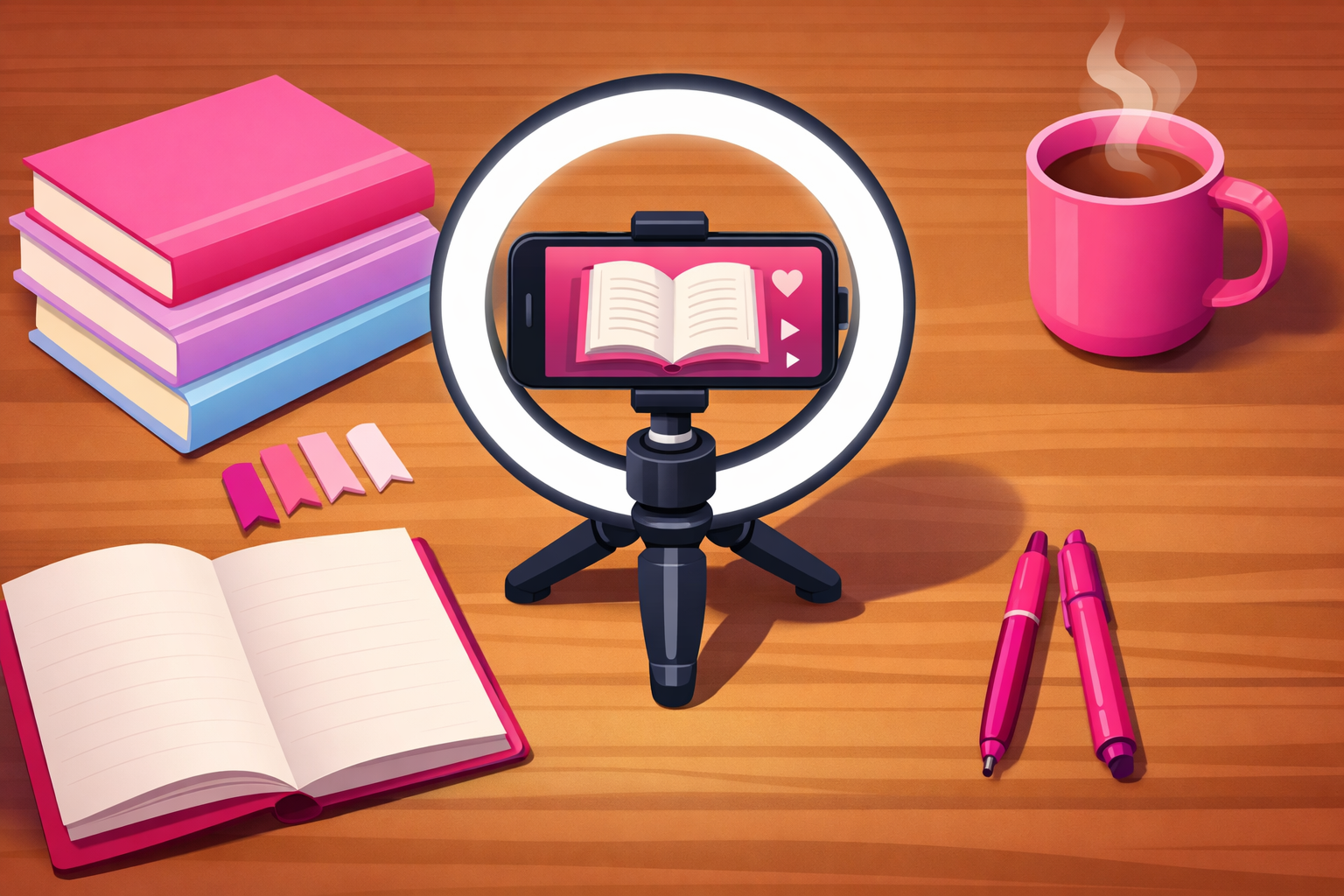
- Ring light or soft LED panel ($25-50) — Only useful for nighttime annotation videos. Daylight beats it every time.
- Lavalier mic ($20-40) — Worth it if you do storytime videos. Phone mics are fine if you film in a quiet room.
- Phone tripod with arm extension ($30-50) — Essential for overhead flat-lay shots, which are signature BookTok composition.
- A second phone ($0-?) — Use an old spare as your “always-on filming phone” so you never miss a real reaction because you were scrolling on your main phone.
The 80/20 of BookTok gear: 80% of your video quality comes from a tripod, a clean lens, and a window. The other 20% is gear, vibes, and luck. If you only buy one thing, make it the tripod — nothing else makes you look more like a creator who knows what they are doing.
Lighting Tricks That Make Book Covers Look Cinematic
Lighting is the difference between “cozy book content” and “cell phone in a dim hallway.” Book covers are reflective, glossy, and sometimes foiled, which makes them oddly tricky — but the fix is shockingly simple once you know what to look for.
The Window-First Rule
Sit beside a window with your books between you and the glass, never with your back to the window. Soft daylight from the side wraps around foil titles and dust jackets in a way that artificial light almost never does. The best BookTok lighting on Earth is a slightly overcast morning between 9am and 11am.
The Three-Light Rule for Nighttime
If you have to film at night, do not rely on your overhead light — it casts ugly downward shadows on covers. Instead use:
- One soft LED panel or ring light at a 45-degree angle from your books
- One warm lamp or candle on the opposite side for color and mood
- One small fairy-light strand or backlight behind your shelf to create depth
This three-light setup, used by countless cozy BookTok creators, makes a $0 phone shot look like a tabletop product video. The mix of cool key light and warm accent light is what gives BookTok its signature cozy glow.
Cover-Friendly Tricks
- Tilt foiled covers slightly until you see the title catch the light — that 1-second shimmer is pure BookTok magic
- Diffuse harsh sun with a sheer white curtain or a piece of parchment paper taped over the window
- Avoid mixed colored light — one warm lamp and one cool LED creates orange-and-blue stripes that look strange on book pages
- Lock exposure on your phone before recording so the camera does not auto-brighten when you turn the page
Audio & Voice Setup for Cozy BookTok Vibes
Most BookTok videos use a trending sound, but voice content is where loyalty is built. Whether you whisper a single line or do a full storytime, your audio quality matters more than your camera quality. Here is how to nail it without a studio.
Audio Best Practices
- Pick a quiet room with soft surfaces — carpets, curtains, books, and bedding all absorb echo. Tile bathrooms and bare kitchens are sound traps.
- Get within 6-12 inches of your phone — closer than you think. Even your phone's built-in mic sounds intimate when you are this close.
- Speak at half the volume you think you should — BookTok rewards quiet, almost-asmr energy. Loud, hyped-up energy reads as forced.
- Add the trending sound inside TikTok — not in your camera roll. This keeps you eligible for sound-based discovery and trend pages.
- Layer voiceover at 60-70% volume over a trending sound at 20-30% so both are clear without competing.
For longer storytime BookTok videos — reading-slump confessions, character analyses, publishing storytimes — a $25 lavalier mic clipped under your collar is the cheapest upgrade with the biggest payoff. Listeners forgive shaky video. They will not forgive harsh, echoey audio.
Framing, Composition & the Faceless Filming Toolkit
BookTok has its own visual language, and once you know the dominant compositions, your videos will instantly feel native to the FYP. Here are the framing patterns that perform best, plus the full faceless filming toolkit for creators who do not want to be on camera.
The Big Four Compositions
- •Vertical book stack hero shot — 5-7 books stacked in front of a clean background, slight tilt for movement
- •Overhead flat-lay — books, mug, blanket, candle arranged on a flat surface, shot from directly above
- •Hand-and-page close-up — your hands holding the book or turning a page, faceless and intimate
- •Talking head with shelf or window — you in frame, soft window light, books visible behind you for contextual depth
The Faceless Filming Toolkit
Plenty of BookTok creators with hundreds of thousands of followers have never shown their face. If you want the same option, here are the moves that fill an entire content calendar without ever pointing the camera at you.
Faceless BookTok shot library
- Hand reaches — a hand entering frame to pick up or place a book
- Page-flip macro — a slow finger turn of a single beautiful page
- Annotation close-ups — tabs being placed, lines being underlined
- Stack reveals — books appearing one by one to a beat
- Spine pans — a slow horizontal slide across a shelf
- Reading-pose silhouette — backlit by a window with the book held up, no face visible
- Shadow-play covers — book held so window light casts the title shadow on a wall
Notice that none of these require you to be a videographer. They require you to be a reader with a tripod and a window — which is exactly what you already are.

The 7 Signature BookTok Shots Worth Mastering
If you only ever learn seven specific BookTok shots, you can rotate them across an entire year of content. Here is the highlight reel that the strongest BookTok accounts come back to again and again.
The Signature 7
- The Stack Drop — Place 5-7 books one by one onto the stack, each landing perfectly on a beat. Iconic recommendation format.
- The Cover Reveal Tilt — Hold the book face-down, then slowly rotate it toward the camera so the cover “blooms” into view.
- The Slow Page Turn — A single finger turning a page in slow motion. Perfect ASMR-adjacent watch-time material.
- The Annotation Drop-In — A close-up of your hand placing a sticky tab on a specific line you want viewers to read.
- The Hold-Up Pose — Faceless: book held in front of your face by two hands. Iconic and instantly recognizable.
- The POV Reaction — Phone propped on a stack, you in frame reacting to a chapter, no script. Raw emotion is the entire point.
- The Spine Pan — A slow horizontal slide across your shelf with text overlays naming each title. Great for “recommend me books like this” answers.
Pair any one of these signature shots with a strong concept from our 50+ BookTok content ideas guide and you have a finished video with almost no creative friction. Pick a shot, pick a concept, film it — that is the workflow.
Editing & Captions Inside TikTok
You do not need third-party editing apps to make beautiful BookTok videos. TikTok's built-in editor is genuinely good enough — and using native tools keeps your video eligible for any sound-based or feature-based pushes the algorithm runs on TikTok-edited content.
The Native Editing Checklist
- Trim ruthlessly: Cut anything that does not move the video forward. The first 1.5 seconds especially — no “okay so” intros.
- Use 2-3 hard cuts max: BookTok does not reward flashy editing. Two well-timed cuts beat ten clever ones.
- Sync to the beat: If using a trending sound, line up your cuts and reveals to obvious beats. Use TikTok's waveform view.
- Add a hook caption: Place a 3-7 word text overlay in the first second. “Books that ruined me” works because viewers know exactly what they are watching.
- Use one consistent font: Pick the “Classic” or “Serif” font and stick with it across all your videos for visual identity.
- Caption everything: Auto-captions are free reach. Many viewers watch BookTok without sound at work or in bed.
Pro Tip: The 1-Second Rule
Watch your video back with the sound off. If you cannot tell what the video is about within the first second — from the visual and the caption alone — re-edit. The For You Page is a silent feed by default, and a hook that only works with audio will lose half of your possible viewers before they even hear it.
The 30-Minute Batch Filming Workflow
The biggest reason creators burn out on BookTok is not lack of ideas — it is the mental cost of filming a video every single day. The fix is to batch. Here is the exact 30-minute weekend session that produces a full week of videos with zero daily filming pressure.
The 30-Minute Routine
- Minutes 0-5: Setup. Tripod by the window. Wipe your phone lens. Pull 5-7 books off the shelf that match this week's ideas.
- Minutes 5-15: Film 4-5 short videos. One stack drop, one cover reveal, one annotation close-up, one talking-head reaction. Same outfit, same lighting.
- Minutes 15-22: Film B-roll. 30 seconds of page turns, 30 seconds of shelf pans, 30 seconds of mug-and-book aesthetic shots. You will reuse this for weeks.
- Minutes 22-28: Edit one video right now. Pick the best one, edit and schedule it for the next morning so something is queued. Easy emotional win.
- Minutes 28-30: Caption your file folders. Label the rest of the clips in your camera roll — “EnemiesToLoversReco,” “FoundFamilyTier” — so future you knows exactly what each clip is.
That is it. Five minutes of filming per finished video, ten or eleven minutes of editing across the week, and your weekday evenings stay yours. This is exactly how the most consistent BookTok creators avoid burnout while still posting 4-7 times a week.
Common Filming Mistakes That Quietly Kill Reach
Most BookTok videos that fail are not bad — they have one or two small filming flaws that compound into “the algorithm did not push it.” Catch these and your reach will improve before you change a single thing about your concepts.
Backlighting yourself by accident
If the window is behind you, you are silhouetted and the book covers go dark. Move so the window is in front of or beside you instead.
Filming horizontal by accident
TikTok is vertical. A horizontal upload gets cropped or pillar-boxed and looks instantly off-platform. Always shoot 9:16.
Letting auto-focus pulse mid-shot
Long-press your subject before recording to lock focus and exposure. Otherwise covers visibly soft-and-sharp throughout the video.
Burying the hook past the 2-second mark
The first 1.5 seconds are everything. Lead with the most emotional or surprising frame, not with “hi guys today I want to talk about.”
Ignoring sound at the editing stage
A whispery voiceover under a loud trending sound is unintelligible. Drop the music to 20-30% under any voice clip.
For a deeper breakdown of how the algorithm decides which BookTok videos to push beyond your followers, our TikTok algorithm guide explains the signals the For You Page reads from your first viewers. Once you understand what the system is rewarding, every filming choice gets easier.
Amplifying Your Best BookTok Videos
Filming a great BookTok video is half the battle. Making sure the right readers actually see it is the other half. The most reliable BookTok growth pattern in 2026 is to film consistently, identify which of your videos punch above their weight in the first 24 hours, and put a budget behind those proven winners.
Here is why this works: a video that is already pulling saves, shares, and comments has been validated by the algorithm. Boosting it preserves that social proof and pushes it into new feeds where it can keep compounding. A cold ad cannot replicate that.
A professional TikTok promotion service like Viryze can put your strongest BookTok videos in front of thousands of additional readers in your exact genre — romantasy, dark academia, literary fiction, queer romance, thriller, you name it. Targeted promotion is especially valuable when you are below 10K followers, because the algorithm has not built a clear picture yet of who your ideal audience is. A budget-backed boost helps the For You Page learn faster.
The math is friendly: if a recommendation video already converts 3% of viewers into followers organically, and amplification puts it in front of 30,000 additional readers in your genre, that is roughly 900 net-new followers from a single video. Stack that across your top performers each week and your BookTok growth compounds — and for authors, engaged followers correlate directly with book sales.
For more on the long-game strategy, our ultimate guide to TikTok growth walks through every milestone from 0 to 100K. And if you want the deep dive on amplifying organic videos with paid promotion that does not feel like an ad, the Spark Ads guide explains exactly how to do it without losing the social proof that made the video work in the first place.
Frequently Asked Questions
Do I need a ring light to film BookTok videos?
No. Most viral BookTok videos are filmed in soft natural daylight near a window, which looks more cinematic and cozy than ring light glare anyway. A ring light is helpful for nighttime or annotation close-ups, but a south- or east-facing window between 9am and 11am is genuinely the best lighting BookTok creators have access to.
Can I film BookTok videos without showing my face?
Yes, and many of the biggest BookTok accounts are completely faceless. You can use book stack reveals, annotation close-ups, page-turning shots, hand-only voiceover videos, and aesthetic vignettes. Faceless content actually outperforms talking-head videos in several BookTok niches because it keeps focus on the books themselves.
What phone settings should I use to film BookTok videos?
Film vertical 9:16 at 1080p, 30 frames per second, and lock both your exposure and focus by long-pressing on your subject before recording. Turn off any beauty filter or auto-HDR toggle, since those tend to wash out book covers. Record audio inside TikTok itself when adding a trending sound, but film silent B-roll in your camera app for cleaner export quality.
How long should a BookTok video be?
The current sweet spot is 18 to 35 seconds for recommendations and reactions, and up to 60 to 90 seconds for storytimes or in-depth reviews. The most important factor is completion rate, not length. A 22-second video watched all the way through will out-distribute a 60-second video that loses viewers at the 15-second mark.
Can promoting my BookTok videos really help me sell more books?
Yes, especially when you put a budget behind a video that already has organic traction. Boosting a BookTok video that is already getting saves and shares preserves the social proof that made it work in the first place. A targeted promotion service like Viryze can put a winning video in front of thousands of additional readers in your exact genre, which often turns a strong post into a real bookselling moment for both readers and authors.
Related Articles
- TikTok for Authors: Complete Guide to Growing Your BookTok Audience
- BookTok Content Ideas: 50+ Video Concepts That Sell Books
- How the TikTok Algorithm Works: Complete Guide
- The Ultimate Guide to TikTok Growth
- The TikTok Hook Vault: Openings That Stop the Scroll
- Spark Ads on TikTok: Creator's Complete Guide