You can clear a room with your choreography, your routines rack up views, and your saves are climbing - but your bank account hasn't noticed yet. It's the question every dancer eventually asks: how do I actually turn all this attention into income?
Here's the good news. Dance is the most TikTok-native niche there is - the app grew out of dance and lip-sync - and that means the platform pushes your work harder than almost any other kind of content. The catch is that views alone don't pay. You need to turn that reach into offers people actually buy.
This guide breaks down all seven proven revenue streams for dancers in 2026 - from passive digital income to high-value teaching and bookings - then shows you how to stack them, how to turn views into real sales, and when paid promotion multiplies what you earn. If you haven't read it yet, our complete TikTok for dancers guide covers the growth side; this is the money side.
The short version:
- You don't need a huge following. A handful of local students or one choreography commission can outweigh months of ad payouts. Reach to the right people beats raw follower count.
- Stack streams, don't pick one. The top-earning dancers combine passive products with high-value teaching and bookings.
- Your content is your storefront. Tutorials sell courses; routines book students and brand deals. Every video is doing a sales job.
- TikTok payouts are a bonus, not a plan. The real money is in your own offers, where you keep the full margin.
What's Inside
- 1. Why Dancers Can Earn Faster Than They Think
- 2. The Dancer's Income Stack
- 3. Stream 1: Teaching - Courses & Tutorial Packs
- 4. Stream 2: Local Classes & Memberships (The Big One)
- 5. Stream 3: Choreography Commissions
- 6. Stream 4: Brand Deals & Sponsorships
- 7. Stream 5: TikTok LIVE Gifts
- 8. Stream 6: Merch & Performance Bookings
- 9. Stream 7: TikTok's Own Payouts
- 10. The View-to-Revenue Funnel
- 11. When Paid Promotion Multiplies Your Income
- Frequently Asked Questions
1. Why Dancers Can Earn Faster Than They Think
Most creators have to invent something to sell. A comedy account or a vlogger spends months figuring out a product, building a store, and convincing an audience to care. Dancers skip a lot of that, because you already have a skill people want to learn and watch.
Think about what shows up in a single 15-second routine. There's the choreography (sellable as a tutorial or course), the skill (sellable as a class or workshop), the style (which attracts brand deals), and the performance (which books gigs). One clip quietly advertises four different revenue streams at once.
There's a second advantage that's easy to miss: dance has an unusually short path from view to revenue, especially locally. When someone in your city watches your studio routine, they're not just a fan - they're a potential student worth a recurring monthly membership. That's why even a modest dance account can out-earn a much larger entertainment one.
2. The Dancer's Income Stack
Before we go stream by stream, understand the strategy that ties them together. We call it the Dancer's Income Stack™ - and it's the single biggest mindset shift between dancers who make pocket money on TikTok and those who dance for a living.
The mistake is picking one income stream and hoping it carries you. The reality is that each stream does a different job, and they reinforce each other when stacked:
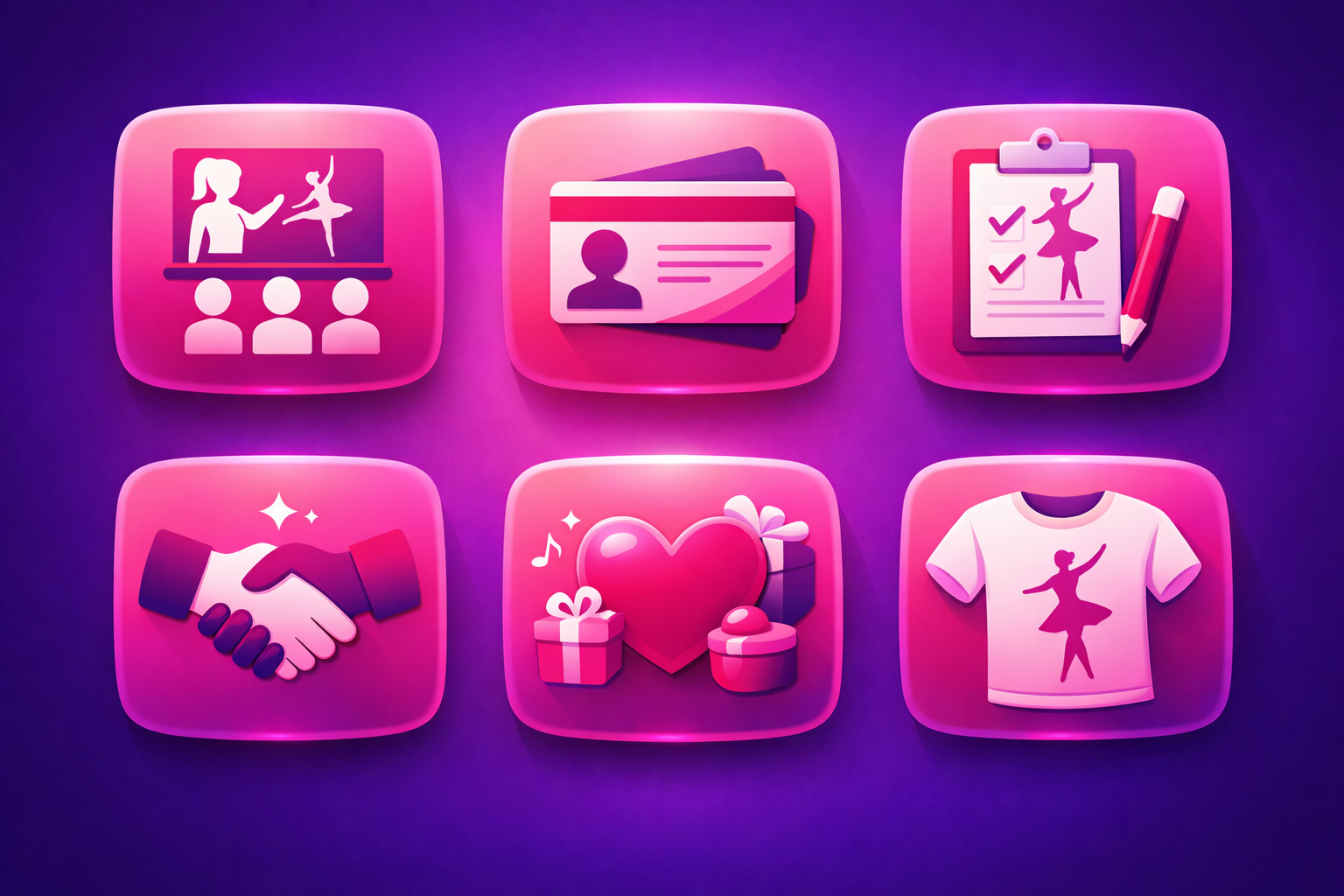
- Passive layer (courses, tutorial packs, merch): Steady, scalable income that grows with your audience while you sleep. Make it once, sell it forever.
- High-value layer (local classes, choreography commissions, bookings): The big paydays. Fewer transactions, but each one can be worth months of product sales - especially recurring class memberships.
- Authority layer (brand deals, sponsorships): Income that arrives once you're seen as a name in your style - and which makes every other stream more valuable.
Stacked together, these smooth out the feast-or-famine cycle dancers know too well. A quiet booking month is covered by course sales; a viral routine that fills your next workshop funds your studio rent. Build the layers in order - passive first, then high-value, then authority - and you create a business, not a side hustle.
3. Stream 1: Teaching - Courses & Tutorial Packs
Teaching is the fastest scalable income most dancers can build, and TikTok is the perfect place to sell it. Why? Because your tutorial clips are already advertising the exact thing you sell. Every time you break down a move and viewers save it to try later, they're telling you the same thing: "I want to actually learn this."
The product menu is wider than a single class. You can sell a full choreography breakdown, a technique program (turns, isolations, footwork, musicality), a tutorial pack of your most popular routines, or live online classes over video call. They all share the magic of digital goods - you create them once and sell them an unlimited number of times.
How to price and package
Most successful dance courses sell for $30 to $150 depending on depth, while live online classes run $10 to $30 per session and monthly memberships sit around $10 to $30. Tie every launch to a specific video that shows the routine or skill people will learn - the clip is the sales page. Pin it, link the course in your bio, and mention it in the caption.
The selling motion mirrors what we cover in our 50+ dance content ideas - tutorial and breakdown formats aren't just engagement bait, they're the top of your teaching funnel.
4. Stream 2: Local Classes & Memberships (The Big One)
If you teach in person, this is where the real money lives. A single student who joins a weekly class can be worth $50 to $150 a month - and they often stay for a year or more. Fill one class of fifteen students and you've built recurring income that dwarfs almost any other stream. And TikTok is shockingly good at filling those classes.
Here's why: when you post a routine or a clip from a real class, the people who see it in your area aren't just fans - they're the exact humans who sign up for dance classes. A teen wanting to learn hip-hop, an adult beginner nervous about their first heels class, a parent looking for a kids' program. Your content is a class preview and an ad at the same time.
How to turn views into class signups
- Show the room, not just the routine. Students join a feeling - how welcoming, fun, and supportive your class is. Film the energy and the real students (with permission), not only the polished choreography.
- Make your location obvious. Put your city and studio in your bio and captions. Local intent is what converts views into signups.
- Add a clear signup link. Your link in bio should go straight to your class schedule or a trial-class booking - never make a potential student hunt.
- Post beginner wins. A nervous first-timer nailing the routine by the end of class is irresistible content and powerful proof that anyone can start.
Because class memberships are so valuable and recurring, they're also the stream where paid promotion pays off fastest - a single amplified class clip that fills even a few seats can return many times its cost. We'll come back to that in section 11.
5. Stream 3: Choreography Commissions
If your strength is creating original routines, choreography is a high-value service people will pay real money for. Recording artists need routines for music videos and tours, brands want signature moves for campaigns, other creators commission dances to post, and event organizers hire choreographers for showcases and competitions.
TikTok is the ideal portfolio for this work, because your feed is living proofthat you can build moves people want to copy. When a brand or artist sees one of your routines spread across the app, you've already answered their only real question: can this person create something that catches on?
How to attract commission work
- Show your originals. The more recognizably yours a routine is, the more valuable your choreography becomes. A signature style is a selling point.
- Tag and credit yourself. Make sure your name travels with your moves. When a routine spreads, you want everyone to know who built it.
- List a contact for work. A simple "choreography inquiries" line and email or form in your bio tells brands and artists you're open for business.
Commission rates vary widely, but original choreography for a brand, artist, or event commonly runs from a few hundred to several thousand dollars per project, depending on usage and your profile. It's a part of the high-value layer that grows directly with your reputation.
6. Stream 4: Brand Deals & Sponsorships
Dance sits in a rich brand-deal ecosystem on TikTok. Dancewear and athleisure labels, sneakers and dance footwear, hydration and energy drinks, music apps and headphones, and even beauty brands - these companies all spend real money on creators who reach their exact audience and look great in motion.
The encouraging news is that niche relevance beats raw size for dance brand deals. A 20K-follower account known specifically for heels or breaking is more valuable to a dancewear brand than a 200K general account, because every follower is a buyer of that gear. Brands pay for fit, not just numbers.
How to attract brand deals
- Wear and feature gear naturally first. Dance in the shoes, the leggings, the brand you love. Companies notice creators already representing them.
- Keep a simple media kit. One page with your style, audience, and best-performing routines makes you easy to say yes to.
- Protect your trust. Only promote gear you'd actually dance in. One inauthentic ad costs you more credibility than the deal is worth.
Brand deals are part of the authority layer - they tend to arrive after you've built a recognizable style, and they grow as your reputation does.
7. Stream 5: TikTok LIVE Gifts
TikTok LIVE is one of the most natural fits for dancers, because live dancing is genuinely fun to watch and easy to reward in the moment. When you go live, viewers can send virtual gifts that convert to real money, and an energetic dance LIVE - taking song requests, doing challenges, freestyling - can pull in gifts steadily.
The best LIVE earners treat it like a show, not a hangout. They set a theme ("request a song, I'll choreograph it live"), keep the energy high, and thank gifters by name to encourage more. Going live consistently also boosts your reach, so it feeds your other streams even on a slow gift night.
Be realistic, though: LIVE gifts are a variable, supplementary stream for most dancers, not a reliable salary. Treat a strong gift night as a bonus, and use the attention LIVE generates to push viewers toward your classes, courses, and link in bio - where the bigger, steadier money lives.
8. Stream 6: Merch & Performance Bookings
Two more streams round out the picture. Merch turns an engaged audience into passive product income - print-on-demand tees, hoodies, and accessories tied to your style, catchphrase, or crew name. You hold no inventory; the fulfillment service prints and ships, and you keep the margin. Merch works best once you have a recognizable identity people want to wear.
Performance bookings are the high-value side: paid gigs at events, corporate parties, music videos, competitions, brand activations, and showcases. TikTok acts as your reel - an organizer who finds your routine sees exactly what they'd be hiring. A clear "available for bookings" line in your bio with a contact turns curious viewers into paid gigs.
Neither stream needs a massive following to start. A local event planner doesn't care if you have 8K or 80K followers - they care whether your performance fits their show. As with bookings everywhere, fit and reach to the right people beat raw audience size.
9. Stream 7: TikTok's Own Payouts
TikTok can pay you directly through its Creator Rewards Program for qualifying videos over one minute, once you hit the eligibility requirements. It's real money - but for dancers it should be the smallest, last stream you count on.
The reason is simple math. Direct payouts typically amount to a few dollars per million qualifying views, and they fluctuate constantly. Compare that to one course sale or a single class signup, and it's clear where your energy should go. Chasing watch-time payouts can even pull you toward longer, less danceable content that hurts your real growth.
The principle holds across the platform: the platform paying you is the weakest form of monetization, because you keep the smallest cut. Use TikTok's reach to drive your own offers - classes, courses, commissions, bookings - where you keep nearly all the margin. Treat any direct payout as a nice bonus on top.
10. The View-to-Revenue Funnel
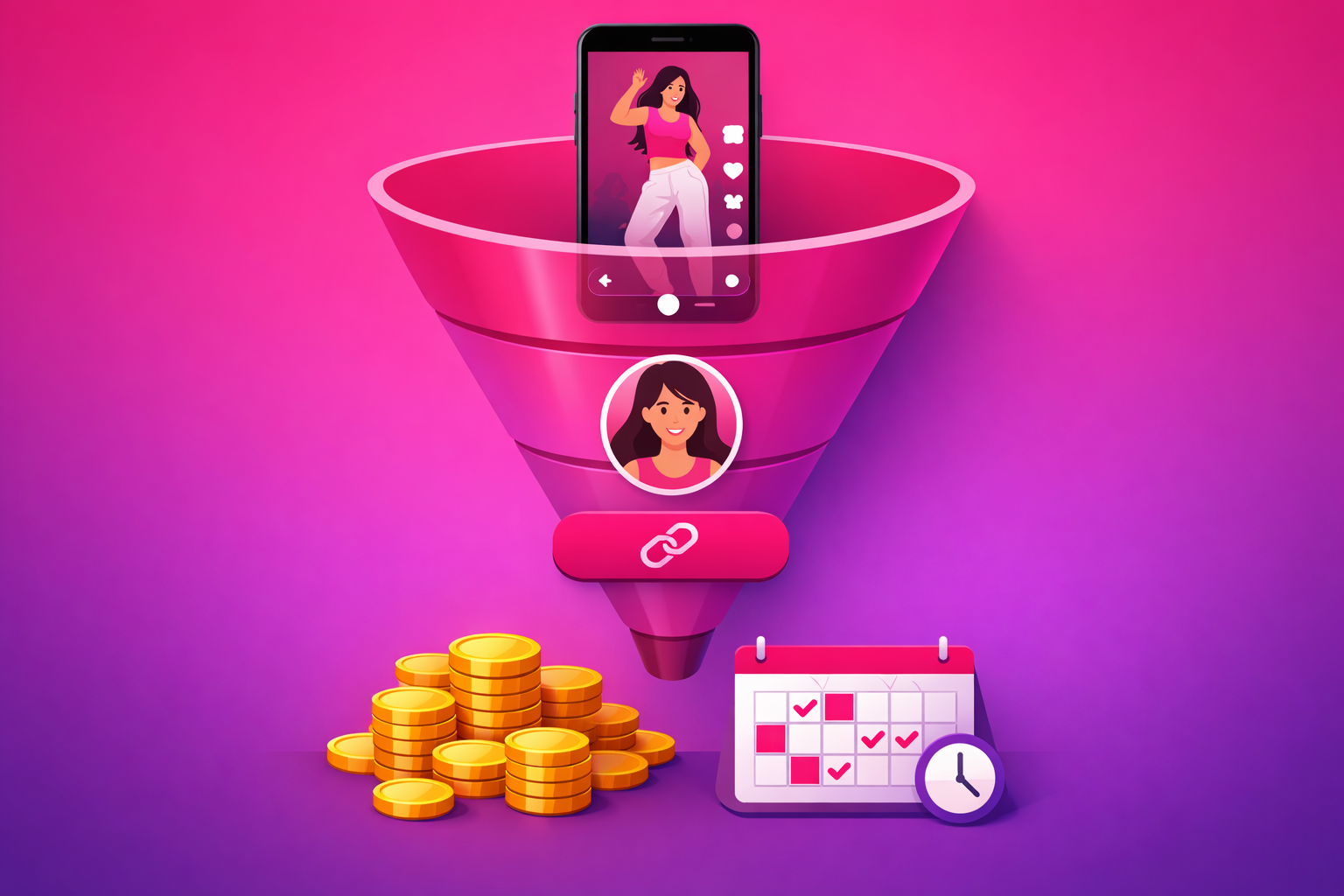
Having seven streams means nothing if viewers can't find their way to your offers. The gap between "great routine" and "money in your account" is a simple funnel, and most dancers leak revenue at one of these steps.
- The video earns attention with a beat-drop open or a move that makes people stop scrolling and rewatch.
- The profile tells visitors instantly who you are and what you offer - your style, your city, and one clear next step.
- The link in bio routes them to the right destination: a class schedule, a course page, or a booking form.
- The offer closes it - clear pricing, easy signup, no friction.
Audit your own funnel honestly. The most common leak is a vague profile and a generic link that doesn't match the routine that brought someone there. If your viral clip is a class preview, your link should lead straight to your schedule - not your homepage. Match the destination to the content and your conversion rate climbs immediately. Our dancer growth roadmap covers building the audience that feeds this funnel in the first place.
The one-tap rule
Every offer should be reachable in one tap from the video that promotes it. Each extra step between a viewer's impulse and your signup loses a chunk of buyers. Pin the video, link the exact class or course, and remove every click you can.
11. When Paid Promotion Multiplies Your Income
Once your funnel converts and you know which routines drive sales or signups, paid promotion becomes the highest-leverage tool in your kit. The logic is simple: if a clip already turns views into revenue organically, putting more of the right people in front of it multiplies that revenue.
This is exactly where it pays to be selective. You don't promote every upload - you wait for a routine that's already proven it can sell (a high-save tutorial that moves a course, or a class clip that generated local signups), then put budget behind that specific winner. Promotion amplifies signals that already exist; it can't create them. Dance content is unusually well-suited to this because rewatchable routines build exactly the organic momentum paid reach loves to scale - something our TikTok algorithm guide breaks down in detail.
That's the entire idea behind our TikTok promotion service: instead of spraying budget across everything you post, we amplify the dance clips that have already cleared the organic threshold - the ones earning saves, shares, and profile clicks. For dance teachers and studios especially, that targeted local reach converts directly into class signups, which is why a single amplified routine can pay for itself many times over.
If you want to see the mechanics, our Spark Ads guide and the complete TikTok advertising guide walk through every step. The bottom line: build your income streams, prove your funnel works, then use selective amplification to pour fuel on the content already making you money.
Frequently Asked Questions
How do dancers make money on TikTok?
Dancers make money on TikTok in seven main ways: teaching through online classes, courses, and tutorial packs; filling local studio classes and memberships; choreography commissions for artists, brands, and events; brand deals with dancewear, footwear, and lifestyle companies; TikTok LIVE gifts; merch and performance bookings; and TikTok's own creator payouts. The smartest dancers combine several of these into an income stack rather than relying on one. For dance teachers and studio owners, local class bookings are usually the largest stream because TikTok reach converts directly into paying students, while courses and tutorial packs provide passive income that scales with audience size.
How many followers do you need to make money as a dancer on TikTok?
Far fewer than most people think. Dance teachers have filled local classes and landed paid bookings with under 2,000 followers, because a few local students can be worth hundreds of dollars a month - what matters is whether the right people in your area see you dance. For selling courses or tutorial packs, you can start earning at around 3,000 to 5,000 engaged followers, and income scales with audience and save rate from there. Brand deals and TikTok LIVE gifts generally reward more reach (often 10K+), but for most working dancers they are a supplement, not the foundation.
What is the most profitable way for dancers to monetize TikTok?
It depends on whether you teach. For dance teachers and studio owners, filling local classes and memberships is by far the most profitable stream, because a single student who joins a recurring class can be worth far more over a year than thousands of views. For touring or online-first dancers, teaching through courses and choreography commissions tends to earn the most. Digital products like tutorial packs are the most scalable - you make them once and sell them forever - so the highest-earning dancers pair high-value local or commission work with passive digital sales.
Can you make money teaching dance online from TikTok?
Yes - teaching is one of the most reliable and highest-margin ways dancers earn from TikTok, because every tutorial you post is a free sample of a paid product. When viewers save your move breakdowns and ask "how do you do that?", there is demand for a deeper version. Dancers sell one-off courses (a full choreography breakdown or technique program, typically $30 to $150), live online classes ($10 to $30 per session), tutorial packs, and recurring memberships where you teach new routines each month. Because you keep nearly all the margin on your own products, teaching often out-earns brand deals and platform payouts combined.
Does TikTok pay dancers directly for views?
TikTok can pay you directly through its Creator Rewards Program for qualifying videos over one minute, and through LIVE gifts when you go live, but for most dancers these payouts are small and unpredictable - often just a few dollars per million qualifying views. Treat TikTok's direct payouts as a bonus, not a business model. The real money for dancers comes from using TikTok's reach to drive your own offers: classes, courses, commissions, and bookings where you keep the full margin instead of relying on the platform to pay you.
Turn your best routines into more income
Once you know which clips actually drive course sales or class signups, the fastest way to grow your income isn't posting more - it's putting your proven winners in front of more of the right people. Viryze amplifies the dance clips that have already earned their reach organically, so your spend compounds the content that's making you money instead of rescuing the content that isn't. Whether you're filling classes, selling courses, or booking gigs, selective amplification turns your best work into real revenue.
See how selective amplification worksRelated Reading
- TikTok for Dancers: The Complete 2026 Guide - the full playbook for growing and monetizing a dance audience.
- Dancer Growth on TikTok: From 0 to 100K Followers - build the audience that makes every revenue stream possible.
- Dance TikTok Content Ideas: 50+ Video Concepts - the formats that sell courses, fill classes, and book gigs.
- TikTok for Small Business - extra tactics for studios and teachers running a local service business.
- The Complete TikTok Advertising Guide - how paid promotion multiplies the routines that already sell.

Head of Creator Success at Viryze
TikTok growth strategist helping creators reach their first 100K followers through data-driven promotion strategies.