
You've built a library of finance content on TikTok. Your videos explain budgeting, break down investing concepts, and help people make smarter money decisions. But organic reach has limits—and the algorithm doesn't always deliver your best work to the people who need it most.
That's where TikTok advertising comes in. Paid promotion lets you put your strongest finance videos in front of targeted audiences who are actively interested in money topics but haven't discovered your channel yet. It's the fastest way to turn great content into consistent follower growth.
This guide covers everything finance creators need to know about TikTok ads—from choosing the right ad format and setting up targeting to managing your budget and measuring what actually works.
Finance TikTok advertising by the numbers:
- #FinTok—100 billion+ views, making finance one of TikTok's highest-value content verticals
- Finance creators earn $8-$25 CPM on brand deals—2-5x the platform average, reflecting audience quality
- TikTok ad costs start at $0.02-$0.08 per view—significantly lower than YouTube or Instagram for targeted finance audiences
- Spark Ads generate 142% higher engagement than standard in-feed ads, making them ideal for finance education content
What's Inside
- 1. Why Finance Creators Should Consider TikTok Ads
- 2. TikTok Ad Formats That Work for Finance Content
- 3. How to Target the Right Finance Audience
- 4. Budgeting and Bidding Strategies
- 5. Creating Finance Ads That Actually Convert
- 6. Measuring and Optimizing Your Campaigns
- 7. Finance Ad Compliance on TikTok
- Frequently Asked Questions
1. Why Finance Creators Should Consider TikTok Ads
Organic growth on TikTok is real, but it's unpredictable. You can post a video that gets 500,000 views one day and 2,000 the next. The algorithm rewards consistency and engagement, but it doesn't guarantee that your content reaches people who are genuinely interested in personal finance.
Advertising fixes that. Instead of hoping the algorithm picks up your video, you pay to put it directly in front of people who follow finance accounts, search for money topics, or engage with investing content. You control who sees your work.

The economics also make sense for finance creators specifically. Because your audience has high commercial value—brands pay premium rates for finance audiences—the cost of acquiring each follower through ads is typically recovered quickly through brand deals, affiliate partnerships, or course sales.
Why paid promotion makes sense for FinTok creators:
- Predictable growth—you control how many new viewers see your content each day
- Audience quality—targeting ensures you reach people who care about finance, not random viewers
- Content testing—ads quickly reveal which topics and formats resonate most
- Compounding returns—new followers from ads engage with future organic posts too
- Competitive edge—while other creators wait for the algorithm, you build consistently
2. TikTok Ad Formats That Work for Finance Content
TikTok offers several ad formats, but not all of them are equally effective for finance creators. The key is choosing formats that feel native to the platform—finance content that looks like an ad gets skipped. Finance content that looks like a helpful video gets watched, saved, and followed.
Spark Ads (Best for Finance Creators)
Spark Ads are the standout format for finance creators. They let you promote your existing organic TikTok videos as paid ads. The promoted video keeps all its existing likes, comments, and shares, which means new viewers see social proof before they even start watching.
This matters for finance content because trust is everything. A video explaining tax strategies that already has 500 comments and 10,000 likes carries more credibility than the same video running as a fresh ad with zero engagement. Viewers are more likely to follow you when they can see that thousands of other people already value your advice.
In-Feed Ads
Standard in-feed ads appear between organic videos in the For You feed. They work for finance creators who want to test new content without it appearing on their profile first. The downside is that they start with zero engagement, which can reduce initial trust with finance-skeptical viewers.
Video View Campaigns
These campaigns optimize for getting the most video views at the lowest cost. They're useful for building awareness—getting your name and face in front of as many people in your target demographic as possible. Pair them with a strong call-to-action to follow for daily finance tips.
Quick format comparison:
- Spark Ads—Best for follower growth. Promotes existing content with social proof intact.
- In-Feed Ads—Best for testing new angles. Fresh content, no existing engagement.
- Video View Campaigns—Best for awareness. Maximum reach at lowest cost per view.
3. How to Target the Right Finance Audience
Targeting is where finance advertising gets powerful. TikTok lets you narrow your audience based on interests, behaviors, demographics, and even the types of content people have recently engaged with. The goal is to find people who are already curious about money topics—they just haven't found your channel yet.
Interest-Based Targeting
Start with TikTok's interest categories. For finance creators, the most relevant options include Personal Finance, Investing, Business & Entrepreneurship, Real Estate, and Financial Services. Layer two or three interests together to reach people who are genuinely immersed in money topics, not just casual browsers.
Demographic Targeting
Age matters for finance content. A video about student loan strategies performs differently with 20-year-olds than with 40-year-olds. Match your demographic targeting to the specific topic of each promoted video. General personal finance tips can target 22-45, while retirement content should target 30-55.
Behavioral Signals
TikTok tracks how users interact with content. You can target people who have recently watched finance videos, engaged with money-related hashtags, or followed finance creators. These behavioral signals help you find warm audiences—people who already watch finance content and are likely to follow another creator who provides value.
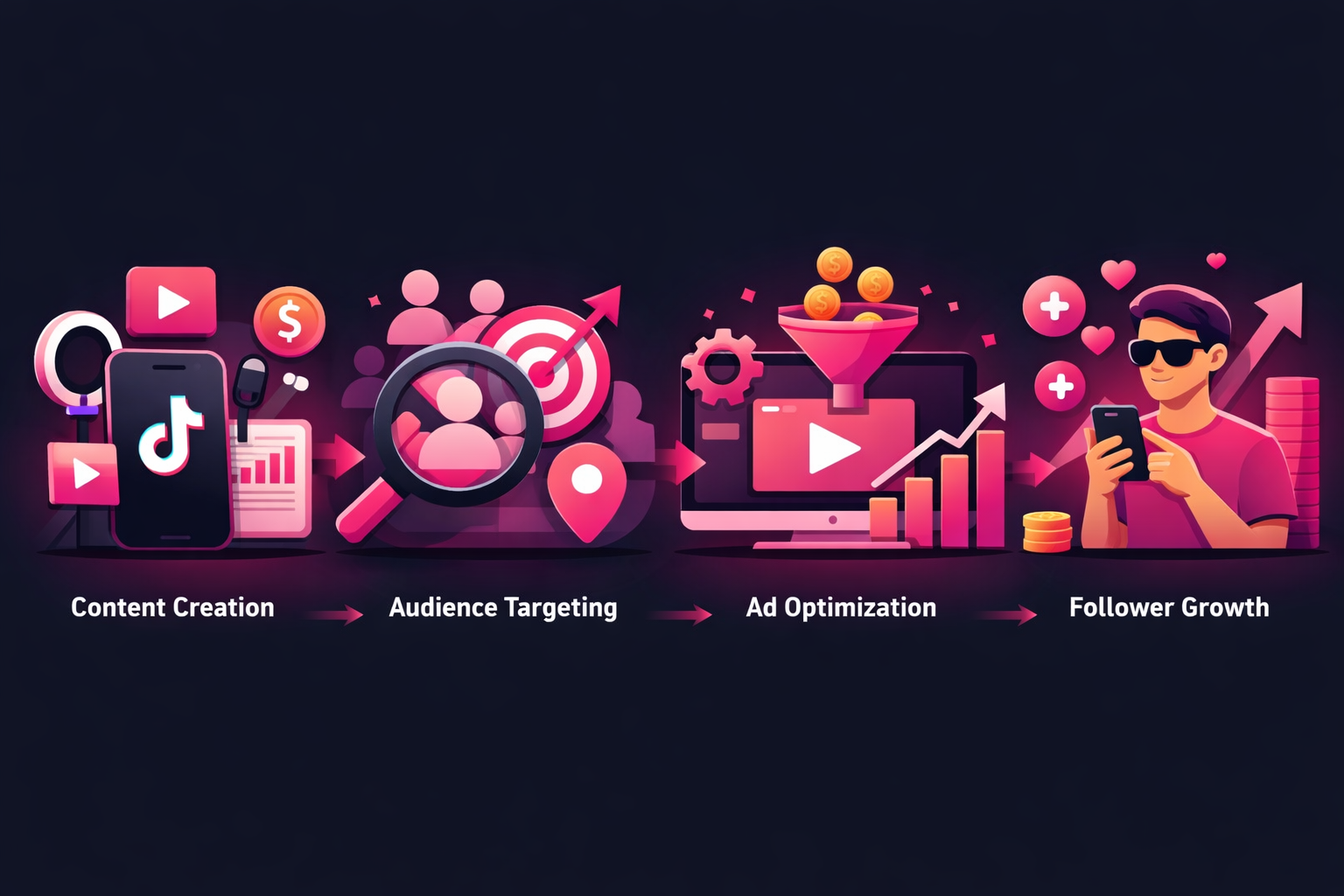
Targeting strategy for different content:
- Budgeting content—Ages 18-30, interests in Personal Finance + Lifestyle
- Investing 101—Ages 22-40, interests in Investing + Business
- Tax strategies—Ages 25-50, interests in Finance + Entrepreneurship
- Real estate—Ages 28-50, interests in Real Estate + Investing
- Crypto/Web3—Ages 18-35, interests in Cryptocurrency + Technology
4. Budgeting and Bidding Strategies
You don't need a massive budget to advertise finance content on TikTok. Most creators start with $20-$50 per day and scale based on results. The platform uses an auction system, so your cost depends on competition for your target audience and how well your content performs.
Starting Budget
Begin with a testing budget of $20-$30 per day spread across 3-5 different audience segments. Run each test for at least 3-4 days before drawing conclusions—TikTok's algorithm needs time to optimize delivery. After a week, you'll have clear data on which audiences respond best to your content.
Cost Benchmarks for Finance
Finance audiences tend to cost slightly more than general entertainment because they're high-value. Expect to pay $0.02-$0.08 per video view and $0.50-$2.00 per new follower. These numbers improve as your ads optimize—TikTok gets better at finding the right viewers the longer a campaign runs.
Scaling What Works
Once you find audience segments that deliver followers at a cost you're comfortable with, increase the daily budget by 20-30% every few days. Don't double your budget overnight—gradual increases let TikTok's algorithm adjust without resetting optimization. Shift budget away from underperforming segments and toward winners.
Budget allocation example ($50/day):
- Week 1—Split $50 across 5 audience segments ($10 each). Test and learn.
- Week 2—Pause 2 underperformers. Reallocate to 3 winners ($16-17 each).
- Week 3—Focus on top 2 segments. Scale to $25 each with proven content.
- Week 4+—Increase total budget as ROI is confirmed. Add new content to test.
5. Creating Finance Ads That Actually Convert
The biggest mistake finance creators make with ads is promoting the wrong content. Your most viewed video isn't necessarily your best ad. The best ad is the video that makes someone want to follow you—not just watch a single clip.
What to Promote
Choose videos that demonstrate your unique value in under 60 seconds. The ideal ad video teaches something specific, shows your personality, and ends with a reason to follow. A video like “3 savings accounts everyone in their 20s should have” works because it delivers immediate value and implies you have more tips to share.
Avoid promoting videos that are part of a series (viewers won't have context), videos that react to news events (they feel dated), or videos that are purely motivational (they don't showcase your expertise).

Hook Structure for Finance Ads
Your first 2 seconds determine everything. Finance content needs hooks that create an immediate knowledge gap. Start with something the viewer didn't know they were doing wrong or a number that surprises them. “You're losing $300 a month and you don't even know it” outperforms “Here are some money-saving tips.”
High-converting hook formulas for finance ads:
- “I wish someone told me this about [topic] when I was [age]”
- “The [number] mistake costing you [dollar amount] every month”
- “Stop doing [common practice]—here's what works instead”
- “How I [financial achievement] in [timeframe] with [simple method]”
- “[Surprising fact] that your bank doesn't want you to know”
6. Measuring and Optimizing Your Campaigns
Running ads without tracking the right metrics is just burning money. For finance creators, the metric that matters most depends on your goal. If you're building an audience, track cost per follower. If you're promoting a course or product, track cost per click to your landing page.
Key Metrics to Track
- Cost Per Follower (CPF)—How much you're paying for each new follower. Target under $1.50 for finance content.
- Video View Rate—Percentage of people who watch past 6 seconds. Above 15% is strong for finance ads.
- Profile Visits—How many ad viewers click through to your profile. Higher is better for follower campaigns.
- Save Rate—How often people bookmark your promoted video. Finance content should aim for 3-5% save rates.
- Engagement Rate—Likes, comments, and shares combined. Healthy ads maintain 5-10% engagement.
When to Pause or Change
Pause any ad group that hasn't delivered results after spending 2x your target cost per follower. If your target CPF is $1.00, pause any audience segment that has spent $2.00 per follower or more without improving. Redirect that budget to your best performers.
Refresh your promoted content every 2-3 weeks. Even winning videos eventually fatigue as the same audiences see them repeatedly. Always have 2-3 new videos ready to rotate into your campaigns.
If managing all of this feels overwhelming, tools like Viryze automate the audience testing, budget shifting, and optimization process—so you can focus on creating great finance content while your campaigns run efficiently in the background.
7. Finance Ad Compliance on TikTok
Finance is one of the most regulated advertising categories on TikTok. Getting this wrong can result in ad disapprovals, account restrictions, or worse. Understanding the rules before you start saves time and protects your account.
What You Can Promote
Educational finance content is generally safe to promote. Videos that teach budgeting methods, explain investing concepts, discuss saving strategies, or share general financial literacy are all fair game. You're promoting knowledge, not a financial product.
What Requires Extra Approval
Ads that mention specific financial products, trading platforms, or investment returns require additional disclosures. If you're promoting affiliate links to brokerages or advertising a paid course that promises financial outcomes, you'll need disclaimers and may face additional review.
Finance ad compliance checklist:
- Never guarantee specific financial returns or outcomes in ad content
- Include disclaimers when discussing specific investments or products
- Avoid “get rich quick” language or unrealistic income claims
- Don't promote unregistered financial services or unlicensed advice
- Use “not financial advice” disclaimers when discussing specific strategies
- Keep copies of all ad content for compliance records
The safest approach is to promote educational content and let your organic profile handle the more specific recommendations. Your ads bring people in, your organic content builds the relationship, and your monetization happens through trusted channels.
For more on staying compliant while creating engaging finance content, check out our complete FinTok guide which covers compliance in depth.
Ready to Grow Your Finance Audience with Ads?
Viryze makes TikTok advertising simple for finance creators. We test multiple audience segments simultaneously, automatically shift budget to your best-performing targets, and handle all the optimization—so you get more followers from every dollar spent.
Stop guessing which audiences will respond to your content. Let data drive your growth while you focus on creating the financial education content your audience needs.
Frequently Asked Questions
How much does TikTok advertising cost for finance creators?
Most finance creators start with $20-$50 per day. TikTok uses an auction system, so costs vary by targeting. Finance audiences typically cost $0.02-$0.08 per video view and $0.50-$2.00 per new follower. Costs decrease as your ads find high-performing audience segments.
What is the best TikTok ad format for finance content?
Spark Ads are the best format for finance creators because they promote your existing organic videos as ads. Your promoted content keeps its likes, comments, and shares, building social proof while reaching new viewers. They feel more natural in the feed than traditional ads.
Can I advertise financial products on TikTok?
TikTok has strict policies around financial advertising. You can promote educational finance content freely, but ads for specific financial products like crypto exchanges, trading platforms, or loan services require additional approvals and disclaimers. Focus on promoting your educational content to avoid compliance issues.
How do I target the right audience for finance ads on TikTok?
Start with interest-based targeting using categories like Personal Finance, Investing, and Entrepreneurship. Layer in age targeting (22-45 for most finance content) and behavioral signals. Test multiple audience segments simultaneously and let performance data guide your budget allocation.
Should I use TikTok Ads Manager directly or a promotion service?
TikTok Ads Manager gives full control but has a steep learning curve. Services like Viryze simplify the process by handling audience testing, budget optimization, and ad management for you. Many finance creators start with a managed service to learn what works, then decide whether to run campaigns themselves or continue with automated optimization.
How long does it take for TikTok ads to start working?
TikTok's algorithm typically needs 3-4 days to optimize delivery for a new campaign. Don't judge performance in the first 48 hours—costs are usually highest at launch and decrease as the system learns which users respond to your content. Give each audience segment at least a full week before making major decisions.
Related Articles
TikTok for Finance Creators: Complete Guide
The definitive guide to growing your FinTok channel from scratch.
How to Make Money as a Finance Creator on TikTok
Every monetization path for FinTok creators, from brand deals to courses.
Investing on TikTok: Build an Audience Around Investment Education
How to grow an engaged InvestTok audience and monetize your expertise.
Finance Influencer Growth: From 0 to 100K Followers
The exact growth strategy for building a FinTok audience from zero.

Head of Creator Success at Viryze
TikTok growth strategist helping creators reach their first 100K followers through data-driven promotion strategies.