You sit down to record a TikTok. You know your subject inside and out. But the cursor blinks, the camera stares back, and you think: “What exactly should I make a video about?”
Every education creator hits this wall. Not because they lack knowledge—but because the gap between what you know and what makes a great TikTok can feel enormous. The good news? That gap shrinks fast once you have a list of proven formats to pull from.
Below are 50+ education TikTok content ideas, organized by category and ranked by how well they perform on the platform. Each idea includes a format suggestion and a tip for making it your own. Bookmark this page and come back whenever you need your next video idea.
Why education content wins on TikTok:
- 800B+ views on #LearnOnTikTok
- 3X higher save rate than entertainment content
- 62% of Gen Z uses TikTok as a search engine for learning
- Education creators see 2-5X higher follower-to-view ratios
What's Inside
Surprising Fact & “Did You Know?” Ideas (1-10)
Fact-based videos are the single best-performing format for education creators. They stop scrollers in their tracks because curiosity is involuntary—when someone hears a claim that contradicts what they believe, they have to keep watching. These videos also get shared heavily because people love being the one who teaches their friends something new.
1. “Did you know this about [everyday thing]?”
Take something everyone uses daily (a microwave, a zipper, a traffic light) and reveal a fact most people don't know. Start with the object on screen before dropping the reveal.
2. “This is wrong in every textbook”
Identify a commonly taught “fact” that's actually outdated or incorrect. Works especially well for science, history, and geography. The controversy drives comments.
3. “The real reason [this thing] exists”
Explain the unexpected origin story behind something common. Why do we shake hands? Why are school buses yellow? The “real reason” hook is irresistible.
4. “One fact from every [subject area]”
Rapid-fire facts from different topics within your niche. “One fact from every planet” or “one fact from every U.S. war.” The list format keeps viewers watching until the end.
5. Number comparison scale
Compare sizes, speeds, distances, or amounts in a way that makes abstract numbers feel real. “If the sun were the size of a basketball, Earth would be this small.” Visual comparisons dominate TikTok.
6. “What happens if you [impossible scenario]?”
Hypothetical questions with scientific answers. “What if the Earth stopped spinning?” or “What if you only ate one food forever?” These get massive engagement because everyone has an opinion.
7. “This costs more than you think”
Reveal the surprising cost of everyday items, processes, or events. Works for economics, science, engineering, and history creators. Money always grabs attention.
8. “Scientists still can't explain this”
Unsolved mysteries in your field. Unexplained phenomena, open questions, and ongoing debates. Viewers love feeling like they're on the edge of human knowledge.
9. Before-and-after knowledge test
Ask a question, let viewers pause to think, then reveal the answer with a full explanation. The pause creates active engagement, and people share it to test their friends.
10. “I learned this at [age] and it changed everything”
Personal discovery stories that teach a concept. The autobiographical angle adds authenticity, and the “changed everything” hook promises a big payoff.

Quick Tutorial & How-To Ideas (11-20)
Tutorials are the backbone of education TikTok. They're the videos people save, rewatch, and come back to. If fact reveals get you views, tutorials get you followers—because viewers trust someone who can teach them something practical. For more on filming techniques that keep viewers engaged, check out our guide on growing an education channel on TikTok.
11. 60-second skill lesson
Teach one small, complete skill in under a minute. How to tie a specific knot. How to convert Celsius to Fahrenheit mentally. The constraint forces clarity, and viewers love the sense of accomplishment.
12. “The trick your teacher never showed you”
Share a shortcut or alternative method for solving a common problem. Mental math tricks, writing hacks, or memory techniques. The “teacher never told you” framing makes people feel like they're getting insider knowledge.
13. Step-by-step breakdown
Take a complex process and walk through it step by step with on-screen text. Recipe for a chemistry experiment, how to structure an essay, how to read a financial statement. Number each step visually.
14. Tool or app tutorial
Show how to use a specific tool related to your subject. A graphing calculator shortcut, a research database, a language learning app. Screen recordings with voiceover work perfectly for this.
15. “How to [topic] in 3 steps”
Simplify any complex topic into exactly three steps. The number three is psychologically satisfying and makes content feel manageable. Works for everything from essay writing to budgeting.
16. Common mistake correction
Show the wrong way first, then the right way. “Stop doing this when you study” or “You're pronouncing these words wrong.” The before/after structure is deeply satisfying.
17. Whiteboard speed-draw explainer
Draw a concept on a whiteboard or tablet while explaining it. Speed up the drawing so it takes 30-60 seconds. The visual creation process is mesmerizing and helps viewers understand abstract ideas.
18. “Watch me solve this” real-time demo
Solve a problem in real time while narrating your thought process. Math problems, coding challenges, logic puzzles. Viewers learn more from watching someone think through a problem than from seeing the polished answer.
19. Beginner vs. expert comparison
Show how a beginner approaches something versus how an expert does it. Side-by-side or sequential. This format works for any skill-based subject and makes viewers aspire to the expert level.
20. “The 5-minute version of [complex topic]”
Compress an entire lecture or chapter into a digestible overview. This works especially well before exam season when students are searching for quick summaries.
Myth-Busting & Misconception Ideas (21-28)
Myth-busting videos are engagement machines. When you tell someone they're wrong about something they've believed their whole life, they either agree passionately or argue in the comments. Either way, TikTok's algorithm rewards the engagement. These videos regularly hit 10-50X the views of a normal post.
21. “Everything you learned about [topic] is wrong”
Bold opening, supported by evidence. Works for history (Columbus didn't discover America), science (taste buds aren't mapped into zones), or language (most grammar rules are made up).
22. “This famous quote was never actually said”
Reveal misattributed quotes and the real story behind them. People share these constantly because they love correcting others.
23. Debunk a viral claim
Find a viral TikTok or social media claim in your field and fact-check it. Be respectful but thorough. Duet or stitch format works perfectly here.
24. “Why [popular belief] is actually backwards”
Take a commonly held belief and show how the opposite is true. “Multitasking doesn't make you productive—it makes you worse at everything.”
25. “This movie got [subject] completely wrong”
Analyze a popular movie or TV show through the lens of your expertise. Lawyers reacting to courtroom scenes, scientists analyzing superhero physics, historians correcting period dramas.
26. “3 things people always get wrong about [topic]”
A focused, digestible list of common misconceptions. Three is the perfect number—long enough to feel substantial, short enough to keep attention.
27. Real-time experiment to prove a point
Demonstrate something counterintuitive with a live experiment. Drop two different objects to show they fall at the same speed. Mix unexpected chemicals. Seeing is believing.
28. “I used to believe this too, until I learned...”
Personal myth-busting. Share a misconception you once held and how you discovered the truth. The vulnerability makes it relatable and the story structure keeps people watching.

Study Tips & Academic Hacks (29-36)
Study content has a massive, built-in audience: students. And students are TikTok's core demographic. These videos perform consistently well because they solve an immediate, urgent problem—especially during exam season when search volume spikes dramatically.
29. Study method breakdown
Explain a proven study technique (spaced repetition, the Feynman method, active recall) and show exactly how to use it. Include a real example from your subject area.
30. “Study with me” ASMR session
Film yourself studying with ambient sounds. These low-effort videos build community and accountability. Many get millions of views because people leave them playing while they study.
31. Note-taking transformation
Show messy notes being transformed into organized, color-coded study material. The before/after visual is highly satisfying. Time-lapse format works well.
32. “How I memorized [X] in one day”
Share your process for memorizing something challenging—the periodic table, all U.S. presidents, vocabulary for an exam. Include the specific technique you used.
33. Exam prep countdown plan
A day-by-day study plan for the week before an exam. “7 days until your exam? Do this.” Practical and timely—post these a few weeks before major exam periods.
34. Productivity setup tour
Show your desk setup, favorite apps, and study tools. Viewers love seeing what successful learners use. Tag products and apps for potential brand partnerships.
35. “What I wish I knew before [exam/course]”
Retrospective advice for students about to start something you've already completed. SAT prep, college applications, specific courses. The hindsight perspective adds credibility.
36. Focus technique challenge
Try a productivity method on camera (Pomodoro, time-blocking, the 2-minute rule) and share your honest results. The experimental format is engaging and viewers appreciate the transparency.
Storytelling & History Ideas (37-44)
Stories are how humans have shared knowledge for thousands of years, and TikTok is no different. A well-told story holds attention better than any other format. These ideas work for any subject that has human stories behind it—which is essentially every subject.
37. “The most [adjective] person you've never heard of”
Profile an overlooked historical figure or unsung expert. The “never heard of” framing creates instant curiosity. Works for every academic discipline.
38. Mini-documentary in 60 seconds
Tell a complete story arc in one minute. Set the scene, build tension, deliver the conclusion. Use dramatic music and pacing. Series of these become binge-worthy.
39. “On this day in history”
Daily content that requires minimal planning. Every day has significant events you can connect to your subject. Build a series and your audience will come back daily.
40. “How [famous event] almost didn't happen”
Reveal the unlikely chain of events behind something famous. Near-misses and sliding-doors moments make for gripping content. The “almost didn't happen” hook is impossible to scroll past.
41. Day in the life of [historical figure]
Recreate or describe what a typical day looked like for someone in another era or profession. Comparison to modern life makes it relatable and shareable.
42. “The untold story behind [famous thing]”
Go behind the scenes of something well-known. The invention of the internet, the writing of a famous book, the discovery of a scientific principle. Insider stories always perform.
43. Connect two unrelated events
Show how two seemingly unrelated things are actually connected. “How a volcano in Iceland caused the French Revolution.” The unexpected connection is a powerful hook.
44. First-person historical roleplay
Speak as if you're the person from history. Simple costume or prop, direct-to-camera. “Hi, I'm Nikola Tesla and I'm about to change the world, but nobody believes me.” Immersive and memorable.
Interactive & Challenge Ideas (45-52)
Interactive content turns passive viewers into active participants. These formats generate the highest comment-to-view ratios because they literally ask people to respond. Comments are one of the strongest signals for TikTok's algorithm to push your content further.
45. Pop quiz challenge
Ask a question, give viewers 5 seconds to answer in their head, then reveal the answer. Series format (“Quiz #47”) builds a following of people who come back daily to test themselves.
46. “Rate your knowledge” tier list
Present facts from easy to obscure and ask viewers to comment where they stopped knowing the answers. The tier-list format is familiar to TikTok audiences and drives competitive commenting.
47. “Explain it to me like I'm five”
Take a complex concept and explain it using only simple words and analogies. Then ask viewers to try in the comments. The simplicity challenge makes even experts engage.
48. Spot-the-mistake challenge
Present a problem, sentence, or diagram with a deliberate error and challenge viewers to find it. People love proving they can spot what others miss.
49. “Which one is real?” guessing game
Present multiple options where one is true and the rest are made up. Works for facts, historical events, scientific phenomena. Viewers pause, guess, and check the comments.
50. Answer viewer questions live
Respond to questions from your comments section. This builds community, rewards engagement, and gives you infinite content ideas directly from your audience.
51. “Tell me your [subject] and I'll tell you [something]”
Interactive comment-bait. “Tell me your major and I'll tell you a career you didn't know about.” Follow up with response videos to keep the series going.
52. Duet/stitch a trending video with education context
Find trending content and add your educational perspective. A viral cooking fail? Explain the chemistry. A travel video? Add the geography. This borrows the original video's reach while showcasing your expertise.
How to Pick the Right Format for Your Subject
Not every idea on this list suits every niche. The key is matching your subject matter to the format that makes it most shareable. Here's a quick framework.
| Your Subject | Best Formats | Why It Works |
|---|---|---|
| Science & Math | Experiments, visual comparisons, watch-me-solve | Visual proof is compelling and shareable |
| History & Social Studies | Storytelling, roleplay, “on this day” | Narratives keep viewers watching to the end |
| Language & Writing | Mistake corrections, pronunciation guides, quizzes | Everyone wants to speak and write better |
| Business & Finance | Myth-busting, number comparisons, step-by-step guides | Money topics generate strong emotional responses |
| Tech & Coding | Screen recordings, tool tutorials, beginner vs. expert | Live demos build trust in your technical skills |
| Health & Psychology | Fact reveals, personal stories, debunking viral claims | Health misinformation creates demand for trusted voices |
Start with 3-4 formats from your best-fit category and rotate between them. Once you see which ones resonate with your specific audience, double down on your top performers. Want to get your best-performing content in front of more learners? Viryze helps education creators reach targeted audiences of people who are already interested in learning your subject.
Building a Content Calendar That Keeps You Posting
Having 50+ ideas is meaningless if you don't post consistently. The education creators who grow fastest post 5-7 times per week. That sounds like a lot until you build a system.
The Weekly Theme Framework
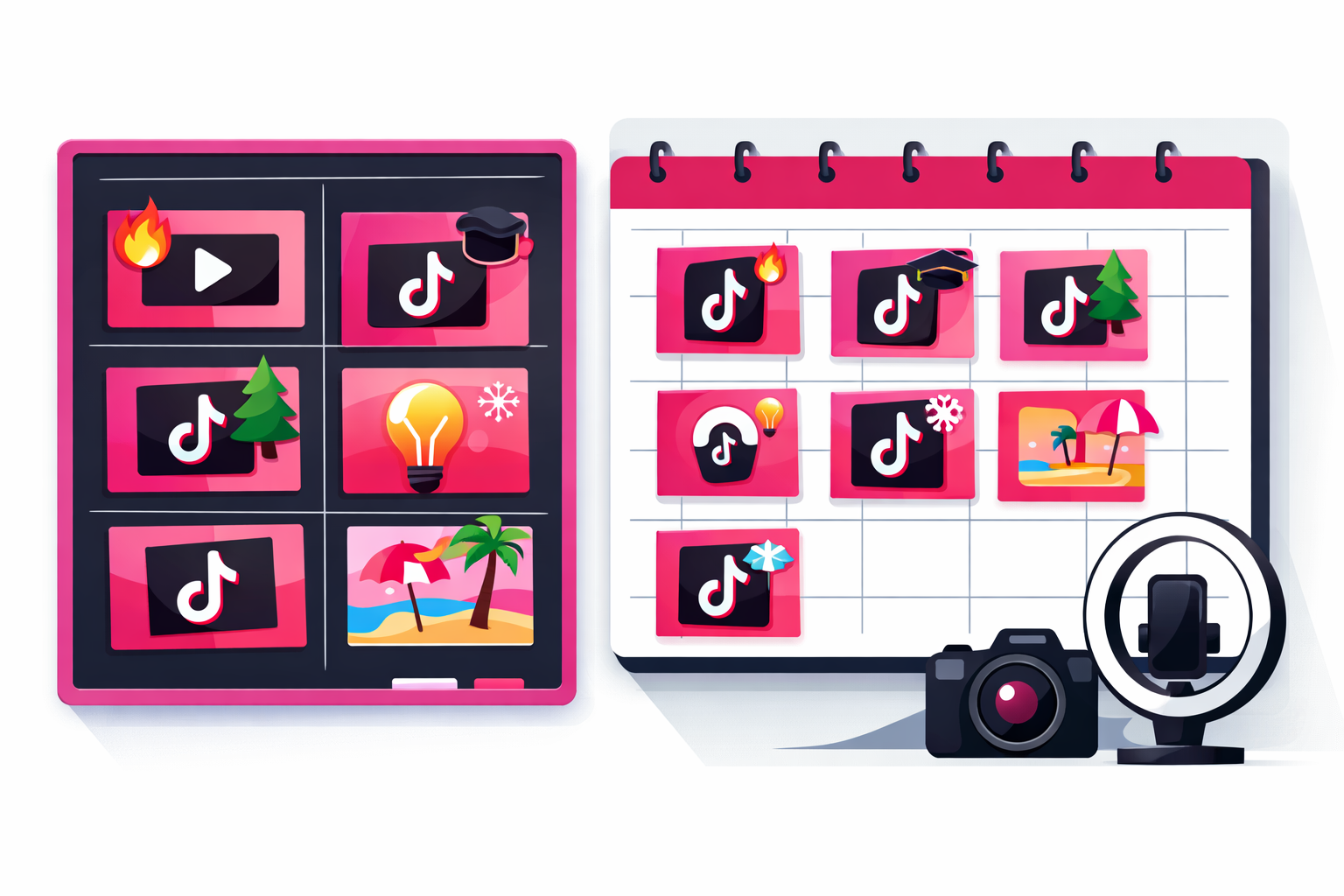
Assign each day a format category. This removes the daily decision of “what should I post?” and replaces it with a much simpler question: “what's my topic for today's format?”
- Monday: Fact reveal or “Did you know?”
- Tuesday: Quick tutorial or how-to
- Wednesday: Myth-busting or misconception correction
- Thursday: Study tip or academic hack
- Friday: Storytelling or history deep-dive
- Saturday: Interactive quiz or challenge
- Sunday: Answer viewer questions or trending topic
Batch Recording
Set aside 2-3 hours once a week to record all your videos for the week. Education content is ideal for batching because you already know the material. Write quick outlines for 5-7 videos, then record them back to back. Schedule them throughout the week using TikTok's built-in scheduler.
Seasonal Content Planning
Plan around the academic calendar for maximum impact. Post exam prep content 2-3 weeks before major test dates. Create back-to-school content in August. Share career advice during graduation season. Seasonal content gets pushed by the algorithm when it matches current search trends.
Accelerate your education channel growth
Great content deserves a great audience. Once you're posting consistently with these formats, you can amplify your reach by promoting your best-performing videos to targeted learners. Viryze helps education creators get their content in front of people who are actively looking to learn—turning views into loyal followers who save, share, and come back for more.
Frequently Asked Questions
What type of education content gets the most views on TikTok?
“Did you know?” fact reveals, myth-busting videos, and quick step-by-step tutorials consistently get the highest views. Content that challenges assumptions or teaches something surprising in under 60 seconds performs best because it drives saves and shares—two of TikTok's strongest ranking signals.
How many education TikToks should I post per week?
Aim for 5-7 posts per week for consistent growth. Education creators can batch-record content around topics they already know, making daily posting realistic. Focus on variety across your content categories rather than repeating the same format.
Do I need to be an expert to create education content on TikTok?
No. Some of TikTok's most successful education creators are students sharing study methods, hobbyists explaining their craft, or professionals breaking down everyday concepts from their field. You just need to know more about your topic than the average viewer and present it in an engaging way.
What hashtags should I use for education TikToks?
Start with #LearnOnTikTok (800B+ views) and #EduTok (500B+ views) as your base tags. Then add subject-specific hashtags like #ScienceTok, #MathTok, #HistoryTok, or #StudyTok. Keep it to 4-6 hashtags total. Niche education hashtags attract more engaged learners than generic tags like #FYP.
How long should education TikToks be?
The sweet spot for most education content is 30-90 seconds. Quick facts and tips work best at 15-30 seconds. Tutorials and explainers perform well at 60-90 seconds. Only go over 2 minutes for complex step-by-step demonstrations. Completion rate matters more than length, so make every second count.
Continue Learning
- TikTok for Education Creators: Complete Growth Guide
The full playbook for building a thriving education channel from scratch.
- How the TikTok Algorithm Works
Understand the signals that determine which videos go viral.
- TikTok Hook Vault: Opening Lines That Stop the Scroll
Pair these content ideas with hooks that grab attention in the first second.
- The Ultimate Guide to TikTok Growth
Broader growth strategies that apply to education creators and beyond.

Head of Creator Success at Viryze
TikTok growth strategist helping creators reach their first 100K followers through data-driven promotion strategies.